Prizes will be awarded to those who guess how many times the word “ancestor(s)” was spoken during the recent Ubuntu conference.
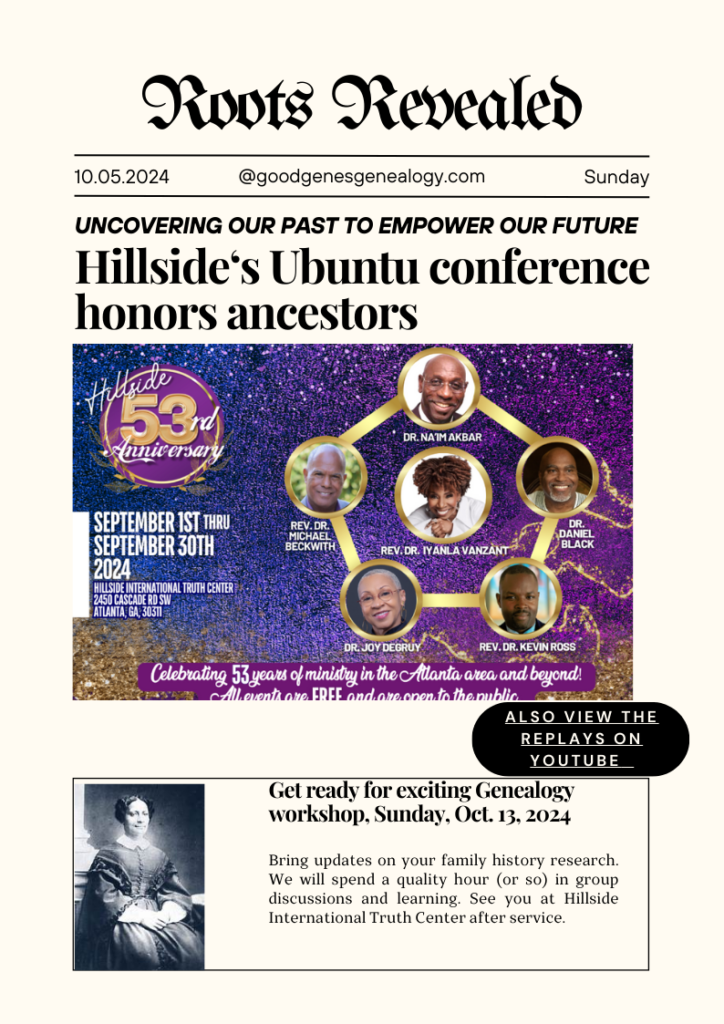
Another free offering from Good Genes Genealogy Services via Dr. Ann Wead Kimbrough

Prizes will be awarded to those who guess how many times the word “ancestor(s)” was spoken during the recent Ubuntu conference.
Another free offering from Good Genes Genealogy Services via Dr. Ann Wead Kimbrough


Memorial Day as we know it, began as a solemn ceremony, known as Decoration Day that honored the U.S. Civil War dead. Thousands of freed slaves in the low country of South Carolina are credited for the beautiful honors bestowed upon the casualties.
_____________________________________________________________________________________________________________________
Happy Decoration Day!
The Good Genes Genealogy team remembers when our Maternal Great Grandmother Edna Robinson would rise early in Omaha, Nebraska with family members so that they would be the first at the cemetery to clean and decorate the humble grave markers. On both sides of my family, we visited the relatives who were buried primarily in Omaha’s Forest Lawn Cemetery. It was a solemn time, yet a memorable time for me as a child.
 Many family members who transitioned before Aunt Beverly had humble grave markers that were reminiscent of the enslaved grave markers of rocks or humble engravings on stone.
________________________________________________________________________________________________________
Little did I know that the humble celebration of the lives of our deceased relatives was born in the kind and respectful practices of Black formerly enslaved women and children. I was unaware because the stories that were passed along through the last century, focused on the well-earned service of U.S. military men and women. However, the origins of Memorial Day are historic, especially for African Americans whose ancestors lived in South Carolina.
“Make sure you are telling the right story,” said Bishop Jack L. Bomar, presiding minister of Atlanta’s Hillside International Truth Center. On the eve of Memorial Day, Bomar reminded the in person and online, worldwide congregation, “Before it was called Memorial Day, it was originally known as Decoration Day.”

____________________________________________________
The Civil War was closing in April 1865 after the Union troops entered the city of Charleston, S.C. Historical accounts reveal that most of the white residents fled the city years earlier. The Black residents of Charleston remained to celebrate and welcome the troops, including the Twenty-First Colored Infantry. It was May 1, 1865 and the first-named Decoration Day later became known as Memorial Day. Even current-day accounts neglect to give credit where credit is due. However, noted historians are reviving the original founding of Memorial Day with great detail.
Historian David Blight retold the story:
During the final year of the war, the Confederates had converted the planters’ horse track, the Washington Race Course and Jockey Club, into an outdoor prison. Union soldiers were kept in horrible conditions in the interior of the track; at least 257 died of exposure and disease and were hastily buried in a mass grave behind the grandstand. Some 28 black workmen went to the site, re-buried the Union dead properly, and built a high fence around the cemetery. The
y whitewashed the fence and built an archway over an entrance on which they inscribed the words, “Martyrs of the Race Course.”
Then, black Charlestonians in cooperation with white missionaries and teachers, staged an unforgettable parade of 10,000 people on the slaveholders’ race course. The symbolic power of the low-country planter aristocracy’s horse track (where they had displayed their wealth, leisure, and influence) was not lost on the freed people. A New York Tribune correspondent witnessed the event, describing “a procession of friends and mourners as South Carolina and the United States never saw before.”
At 9 a.m. on May 1, the procession stepped off led by 3,000 black schoolchildren carrying armloads of roses and singing “John Brown’s Body.” The children were followed by several hundred black women with baskets of flowers, wreaths and crosses.
Then came black men marching in cadence, followed by contingents of Union infantry and other black and white citizens. As many as possible gathered in the cemetery enclosure; a childrens’ choir sang “We’ll Rally around the Flag,” the “Star-Spangled Banner,” and several spirituals be
fore several black ministers read from scripture. (“The First Decoration Day,” Newark Star Ledger).

This grave marker is of an unknown slave. It was placed on this tree after likely being tossed in a Florida storm.

Assigned to command the assault on a South Carolina Confederate fort during the battle at Battery Wagner in July 1863, the 54th Massachusetts Infantry of the Civil War was composed primarily of freed black slaves from northern Union states.
Though the siege was unsuccessful, the heroism of a number of members of the infantry drew the attention of the nation. In particular, Sgt. William Carney risked his life to lead the troops forward, erecting the Union flag. He suffered two bullet wounds but survived, going on to become the first African American to receive the Congressional Medal of Honor for his unprecedented courage.

Researching your family history can be a fascinating journey filled with surprises and connections to the past. With the wealth of free genealogy and ancestry resources available online, uncovering your heritage has never been easier.
Today, on Good Genes Genealogy Services’ Freebie Fridays, here is the offer from The Society of Georgia Archivists is accepting applications for its Brenda S. Banks Scholarship. The scholarship recipient will attend its upcoming SGA Educational workshop on “Writing for Impact: Introductory Grant Writing Workshop” and $100 credit to apply to a Society of America Archivists (SAA) class or purchase in the SAA bookstore.
See attached for more details. click the link — https://soga.org/scholarships/banks.


This photo in a Kentucky food line during the Great Depression was taken by skilled, award-winning photographer, Gordon Parks. He worked for the federal government as part of a massive pictorial project. Gordon specialized in showing Black life in ways never before displayed.
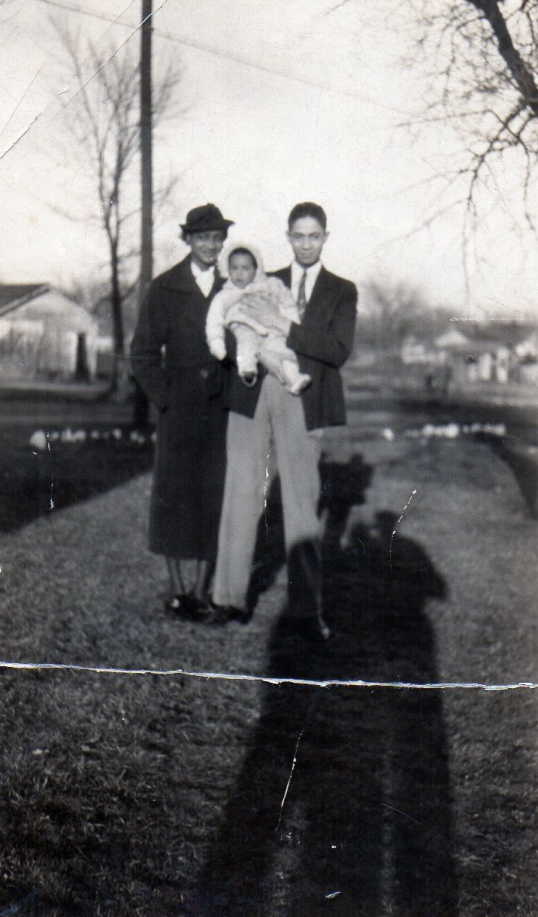
Picture this: You can locate your hard-to-find or perhaps unknown ancestors or important family landmarks through the free pictorial archives of the United States government. I found my father’s childhood home, Logan Fontenelle Homes in Omaha, Nebraska. Once my Dad saw it, he recalled where his neighbors lived and some of the children in the picture found below:
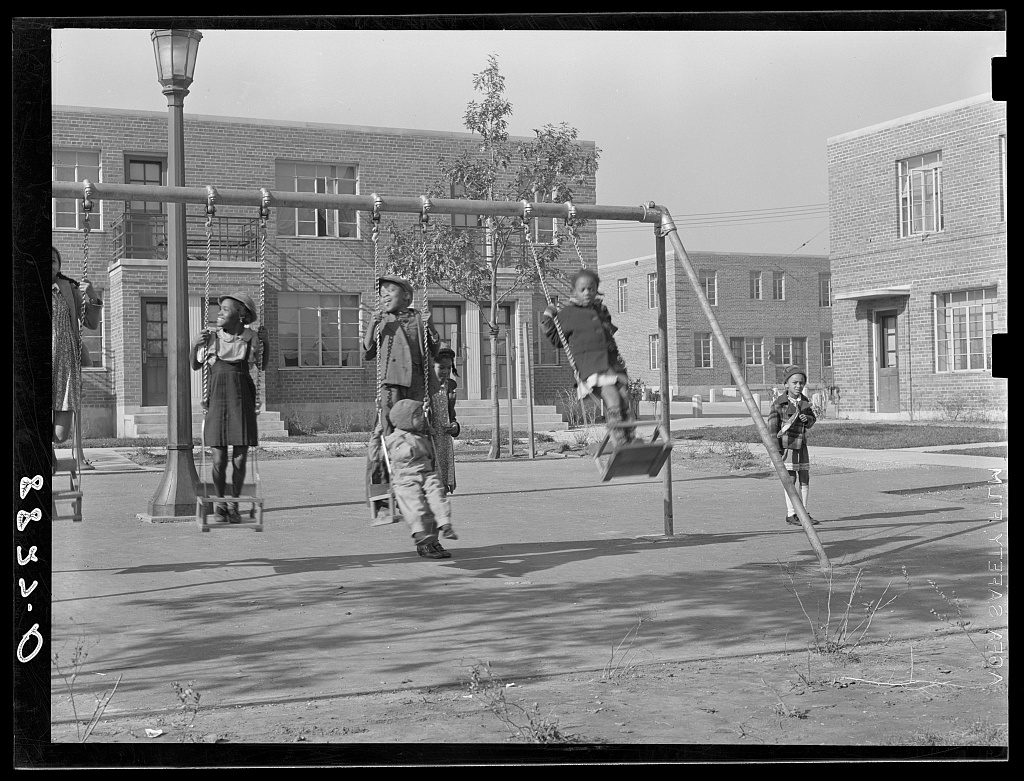
Not only did this photograph prompt my Dad to zero in on the housing development his family (Mom, brother, sister, and grandmother) moved into a few years after this photo was taken, it provided a guide to additional legacy conversations. Thanks to the ambitious nationwide pictorial project by the U.S. Government in the 1930s and 1940s, finding relatives — especially African American ancestors — can prove rewarding.
This blog will give you tips on how to narrow your searches to sites that likely hold images of your ancestors. I located my relatives in the photographs taken in the 1930s and 1940s by photographers employed by the Farm Security Administration and Office of War Information. It was an ambitious project that had multiple goals. One was to employ individuals during a time of desperate unemployment woes of the Great Depression and post-World War II.
When it comes to tracing your family history, there are a multitude of resources available to you. One often-overlooked source of valuable information is U.S. government photos. From census records to military photos, these images can provide a unique glimpse into the lives of your ancestors. By delving into the past through these official images, you can uncover hidden stories and connections that may have been lost to time.
The FSA and the OWI collectively produced approximately 175,000 black-and-white film negatives and 1,600 color photographs during the 1930s and 1940s. The separate agencies’ work was designed to display life during the Depression, Dust Bowl and in the post War World II era.
The caption reads: “Negroes catching small catfish with their hands. Bait to be used in shoals of Little River near Eatonton, Georgia”

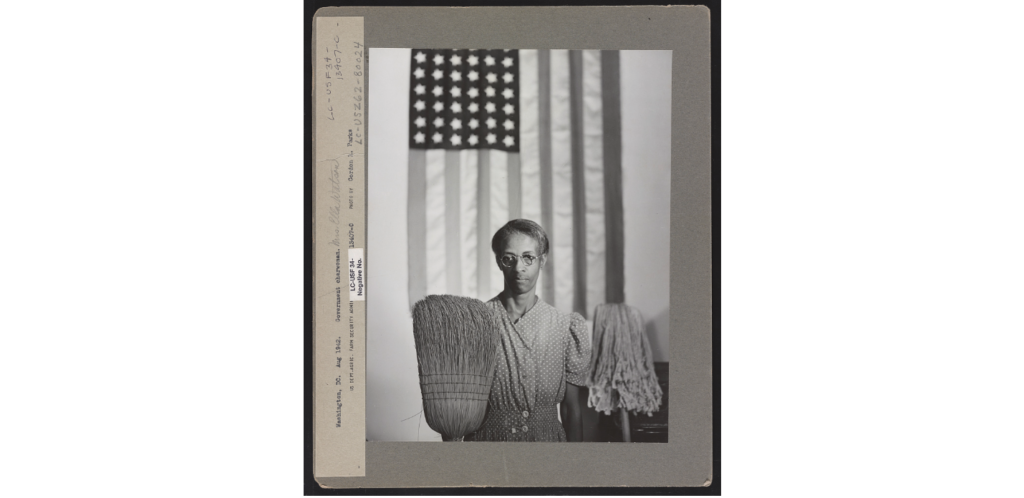
What’s important about this photograph is the name of the subject, Ella Watson, and her occupation, charwoman. A charwoman cleans houses and offices for her wages.
Unprinted negatives: You can search for “Untitled” to see images that did not come with a caption card bearing a title and are presumed not to have been printed. Most unprinted negatives simply have “Untitled” as their caption. Some have titles based on similar images that appear to have related content.
To view images that have a hole punched in them (an early method the agency used to indicate the negative should not be printed), you can search “hole punch.”
For insight on FSA selection of images to be printed, see: Fleischhauer, Carl. “Selecting Photographs for the FSA/OWI Print File: a Photo-Assignment Case Study: John Vachon’s Documentation of the Roanoke Farms Resettlement Project, Halifax County, North Carolina, April 1938” (25 June 2020). [pdf, 7.8 mb], http://www.loc.gov/rr/print/coll/Vachon_FSA-1938-RoanokeFarms.pdf.
Browse by Topic: Select from the Subject Index categories: Alphabetical listing or Classfication Number listing
FSA/OWI Written Records: View a description of the written records and a digitized selection of the documents
For a video overview of the collection, see “Documenting America, 1935-1943: The Farm Security Administration/Office of War Information Photo Collection.”
When you locate a photograph on the joint websites, beside the image, there is a lot of great information that can aid in locating ard-to-find relatives:
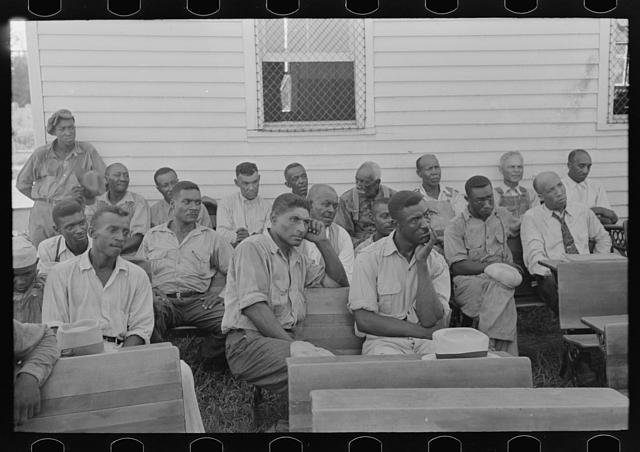
As you delve into locating family members through the U.S. government photos, use the free offerings as a launch or compliment to the images and artifacts in the basements, attics, garages, and other storage areas of your senior relatives. Ask about photographs and piece together fascinating stories.
A creative use is to link the government photographs with the other timelines in your family. Collect and arrange photographs in chronological order and begin with a lively narrative to bring your ancestors to life. Also, look for family resemblances in the government-supplied photographs.
Finally, note that this is another resource to match up information found in military records, the U.S. Census, passports, audio and video captures, and more.


You can hear and feel the heartbeat of Dallas, Texas, as feet and vehicle traffic is nearby the renovated burial grounds that house the remains of between 5,000 and 7,000 slaves, former slaves, freed Blacks, and their descendants. Here lies the historic territory known as the Freedmen’s Cemetery.
It is a sacred site with history that dates to the 186os when the first Black slaves were buried on what was then known as “Freedman’s” town, a place founded by Blacks in the 1850s. The giant arch that is at today’s entry gate to Freedmen’s Cemetery, was the original site that welcomed its residents to the “Freedman’s” community.
Cemeteries, especially those containing the histories of Blacks whose pasts are often forgotten, buried in the historical documents and long forgotten in the storytelling about ancestors. The Freedmen’s Cemetery is a place where stories of struggle, triumph whisper through the winds to tell its special history of its enduring spirit of a community.
During and after the U.S. Civil War, Black slaves and freed ones settled in many areas away from their enslavers and Texas was once the most plentiful state for such “free towns” or “free colonies.” The Freedmen’s Cemetery in Dallas was created to provide a dignified burial place. It was an active burial site between 1869 through 1907, remaining completed supported by Freeman’s town. The area was approximately a mile long in the community of Deep Ellum, Dallas.
The cemetery somehow became forg
otten. In the mid-1940s, the city of Dallas and the federal highway system, built the North Central Expressway and it cut right through the cemetery. The local authorities removed the gravestones and covered the remainder of the center with what became a city park. Some 50 years later in the summer of 1990, the Freedmen’s Cemetery burial ground was “found” after a park renovation. Shortly after, more than 800 marked graves were found. Some 1,200 unmarked graves were found and relocated.
It was also in 1990 that the Freedman’s Cemetery Memorial was created to honor those that were buried. The remembrances brought about community healing. Today, the
cemetery memorial connects a cemetery tour in Uptown, Dallas, and sits near the Emanu-El Cemetery, the Calvary Cemetery, and the Greenwood Cemetery. Since 1992, Freedmen’s Cemetery is a Dallas Landmark . It has been a part of the State Historic Marker program in Texas since 1993.

According to the North Dallas Cultural Center’s “Freedmen’s Memorial: A Place for Healing”:
“Freedman’s Cemetery was one of the largest Freedman Cemeteries in the Country. It was established as a burial ground for Dallas’ early African American population in 1861. The site represents the remnants of the once-thriving North Dallas community which from the Civil War to the 1970s was the largest segregated African American enclave in Dallas and one of the largest in the United States.”

Congratulations!
You are joining millions of individuals around the globe who are beginning their exciting discoveries of families’ histories.
You are in good company whether you are just getting started or dabbled a bit in genealogy. Ancestry research is a popular and engaging hobby for many genealogy seekers, gaining even more momentum over the last decade as accessible online resources. Today, one of the largest ancestry research sites reports some 3 million subscribers searching for 15 million ancestors. Another genealogical network claims another 27 million ancestors in its organization.
Ancestry tracing of your family’s lineage will satisfy more than your curiosity. It is proven to offer comfort, relief, joy, pride, and many positive attributes in the uncovering of the histories of family members often never known. The discoveries also offer many somber and sober moments as our loved ones often had colorful lives. You will see mirrors of yourself and other family members. The rewards of researching family histories bring great rewards.
Let’s get started. This post will show you the way.
First: Set a goal of the essential research you wish to achieve. When I got started with my family’s research, my goal was to learn more about the maternal grandfather that I did not grow up with. I was born in Omaha, Nebraska and my grandfather, Eugene Owen, Sr., lived approximately 1,533 miles away in Los Angeles, California. I also wanted to learn everything about my paternal grandfather who fled Helena, Arkansas after the race killings in 1919. After many years — prior to the ample offerings of online ancestry research — I achieved my initial goals. Keep in mind that your research should be essential to your intended results. You may be interested in building a family tree, learning about your ethnic heritage, or perhaps delving into a specific ancestor’s life story?
Next: Invest in research time both online and offline. This website, goodgenesgenealogyservices.com, and many others offer you access to records. Your county library system, historical societies, archives, family, friends, city tours, and so many resources are available to help fill in the blanks for your ancestry research. Your online records search should yield information to confirm birth, marriage and death certificates. Consult the U.S. Census data for your initial search.
Next: On this site, you can build your family tree. Start with the basics that include your name, date of birth, and other any other relatives’ basic information. Your tree will begin to build itself. Your next steps will be to check in your tree to learn of any updates.
Finally: The exciting part begins with the family puzzle pieces coming together. On your family tree, remember to be flexible and open to unexpected discoveries.
It’s a long and winding journey, yet the results are how you will honor and preserve your family’s legacy.

Today’s freebie is straightforward: Keep researching your ancestry in all regions of the world.
Around the globe, the remnants of African Diasporan appear in most cultures. In this quick installment, see the results of the African American slaves finding safety in Mexico.

Keep digging and learn of the great Gaspar Yanga. A huge statue in Vera Cruz, Mexico, is dedicated to the “Primer Libertador de America or “first liberator of the Americas,” (1545 – 1618) who led one of the first successful slave revolts in colonial Mexico. For years he negotiated with Spain on eleven points, including the ability to establish one of the Americas earliest free black settlements. The town, San Lorenzo de Los Negros was “officially recognized by Spanish authorities as a free black settlement,” according to BlackPast.org. Later, the Mexican town became known as Yanga in honor of its liberator and founder.


For many, the question of where to begin the hunt for their ancestors, is huge.
Here are a few of the questions and comments the Good Genes Genealogy Services (GGGS) team receives from our prospective and new clients:
I am adopted and I don’t know anything about my birth family.
I don’t know my mother’s maiden name.
I don’t know my Dad or his family.
Since the U.S. Census doesn’t have any official records about Black people until 1870 and even that is incomplete, how am I supposed to trace my family back to their arrival in the United States?
I started my family research but then I hit that “brick wall” and cannot move forward. I am ready to give up.
I don’t know anything about my family past my maternal grandmother and my great grandfather on my father’s side.
I heard that my entire family is buried in cemeteries in South Carolina and that’s where I’m from but I don’t know my family’s history.

For African Diasporan-connected family members, the quest to begin the ancestry search may appear to be even more daunting than our counterparts. Yet, we all had to begin somewhere. That’s our first tip:
Those are just a few tips offered to help anyone get started or re-energized to keep up the research for one’s family heritage.
Everyone’s journey is different. Yet, there are similarities in our collective ancestry research efforts based on our listening skills, questioning of relatives, learning new techniques, and jumping in the swim of family research.
This wonderful event is from the Wilson Griot Legacy site:
The Wilson Griot Legacy is a modern enterprise to create new sacred storytelling to unravel information inherent in our genealogical past.
Posted byWILSON GRIOT LEGACYSeptember 9, 2023Posted inUncategorized
I will be joining with the Kinseekers Genealogical Society of Lake County, Florida in conjunction with the Leesburg Public Library in a special event on Saturday, September 23, 2023.
Both in-person and virtual event:

Saturday, 23 September 2023
9:45am – 3:30pm EST
Informal meet ‘n greet at 9:30am EST.
Event is free & open to all!!
Advertisement
Presented by Kinseekers Genealogical Society and the Leesburg Public Library.
To attend virtually, register here.
To attend in-person, contact the Leesburg Public Library at 352.728.9790
MORNING SESSION (9:45am – 12:15pm EST)
–Welcome & Announcements
– Researching Black Family History, 1900-1950: Essential Foundations: presented by Taneya Koonce
–Context Matters: Researching World War Two Black Ancestors:presented by KB Barcomb
LUNCH BREAK (12:15pm – 1:00pm EST)
AFTERNOON SESSION (1:00pm – 3:00pm)
– Colleges, Clubs, & Cotton Fields: Researching Black Women, 1900-1950:presented by Adrienne G. Whaley
– Open Round Table Discussion


Often, reviewing the hatred and violence suffered by African American ancestors, are tough matters to endure and often neglected in history books. Yet, the examples of persevering despite the sad circumstances, can spur on genealogy and ancestry researchers to compare and contrast the past with today’s societal practices.
Good Genes Genealogy Tip: Interview your family members about their sports histories. Some may share the good and also the unhappy times that they or their parents may have endured. Learn how they survived the taunts and personal risks to their families and themselves.
He broke the color barrier in United States’ Major League Baseball. Jackie Robinson did it all, including suffering physical and verbal wounds from his colleagues:
Robinson nonetheless became the target of rough physical play by opponents (particularly the Cardinals). At one time, he received a seven-inch gash in his leg from Enos Slaughter.[135] On April 22, 1947, during a game between the Dodgers and the Philadelphia Phillies, Phillies players and manager Ben Chapman called Robinson a “nigger” from their dugout and yelled that he should “go back to the cotton fields”.[136] Rickey later recalled that Chapman “did more than anybody to unite the Dodgers. When he poured out that string of unconscionable abuse, he solidified and united thirty men.”[137]
https://en.wikipedia.org/wiki/Jackie_Robinson

On her first attempt in the high jump during the International Olympics Games in 1948, Albany, Georgia native Alice Coachman won the gold medal. She became the first African American of any country to win a gold medal. Despite her instant fame and large celebrations back home in the United States, her hometown leaders treated her differently:
Yet these latter celebrations occurred in the segregated South. In the Albany auditorium, where she was honored, whites and African Americans had to sit separately. The white mayor of Albany sat on the stage with Coachman but refused to shake her hand. She had to leave her own celebration by a side door.
https://www.womenshistory.org/education-resources/biographies/alice-coachman
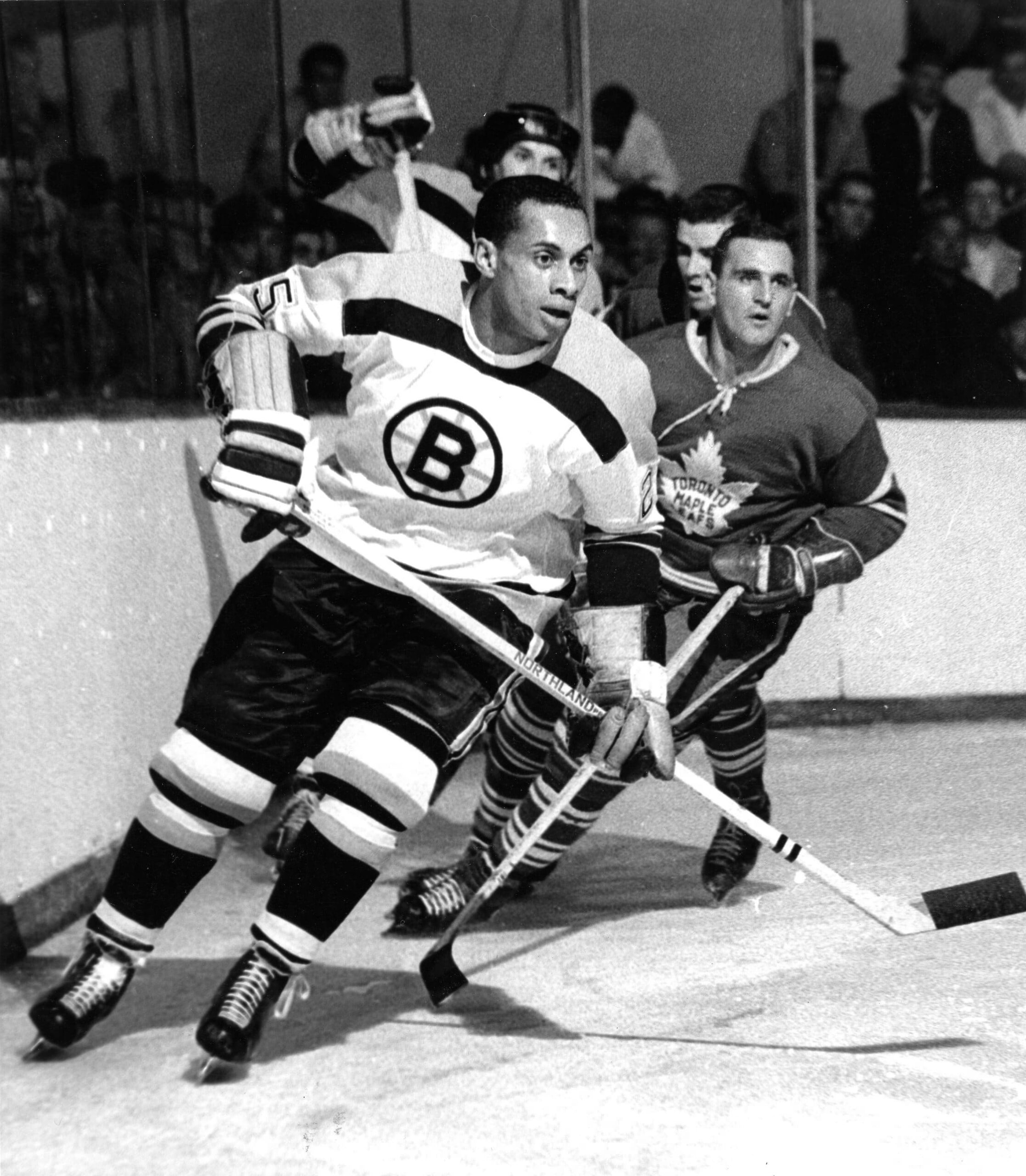
Willie Eldon O’Ree was a youth when he met Jackie Robinson. It helped to inspire O’Ree to pursue his sports passion and became the first African American to join the National Hockey League in 1958. He continues to speak positively about his experiences as a hockey player. Yet, O’Ree suffered many indignities by his fellow league members and fans before retiring in the late 1970s:
O’Ree faced racial taunts throughout his hockey career, including in the NHL, especially in the United States. [11] He noted that racist remarks were much worse in the U.S. cities than in Toronto and Montreal, the two Canadian cities hosting NHL teams at the time, and that “Fans would yell, ‘Go back to the South‘ and ‘How come you’re not picking cotton?’ Things like that. It didn’t bother me. I just wanted to be a hockey player, and if they couldn’t accept that fact, that was their problem, not mine.”[12]
https://en.wikipedia.org/wiki/Willie_O%27Ree

For many years, the Good Genes Genealogy team — Mark and Ann Lineve — did not know much about the man pictured above, our maternal Grandfather Eugene Gibson Owen, Jr. The short story is that Grandpa Owen moved away from the Midwest city and state, Omaha, Nebraska, when our mothers — Lyla and Angeline — were small children in the 1940s. The stories that were whispered around the family was that Grandpa Owen followed his desire to be discovered by Hollywood executives and become a music and movie star.
In 1982, Ann traveled to Los Angeles, California to locate her Grandpa Owen. She did. He was living in a nursing home as a double amputee. For three days, Ann and her husband learned all about the once mystery man in the Owen and Wead families. A few years after that visit, Grandpa Owen died. The deep wounds from his absence in the lives of our relatives were still there. Yet, it was made a bit easier to forgive because our ancestor’s explanations for following his passion, was remembered. Therein, lies the glimpses of healing.
There are mental health benefits in learning more about one’s family. The ancestry and genealogy researchers who are our clients and participated in our workshops, have had similar feelings of joy when learning more about their long-lost ancestors.
Here are a few examples from individuals’ recent finds in their family trees:
In an ancestry and genealogy workshop conducted in 2022 and this year by the Good Genes Genealogy team, we reminded participants to find mental health benefits from their discoveries. We advise that the deep dives into family heritage is:

By now, many of us who are searching for answers to the mysteries of our African Diasporan ancestors have found that the routes to getting research are often nontraditional. Consider another avenue to hopefully find your ancestors.
Tap into your imagination, natural instincts and recall the stories you’ve heard to search for clues about your ancestors’ journeys. Hopefully, you will find a new detail to help break through those brick walls.
If your ancestors worked at the Ford Motor Co. in the 1960s in Queens, New York, they may have known or been on the team with McKinley Thompson, Jr. an African American who designed cars during his 28-year career with the automaker. He was part of the concept team for the first-generation Mustang and GT40.
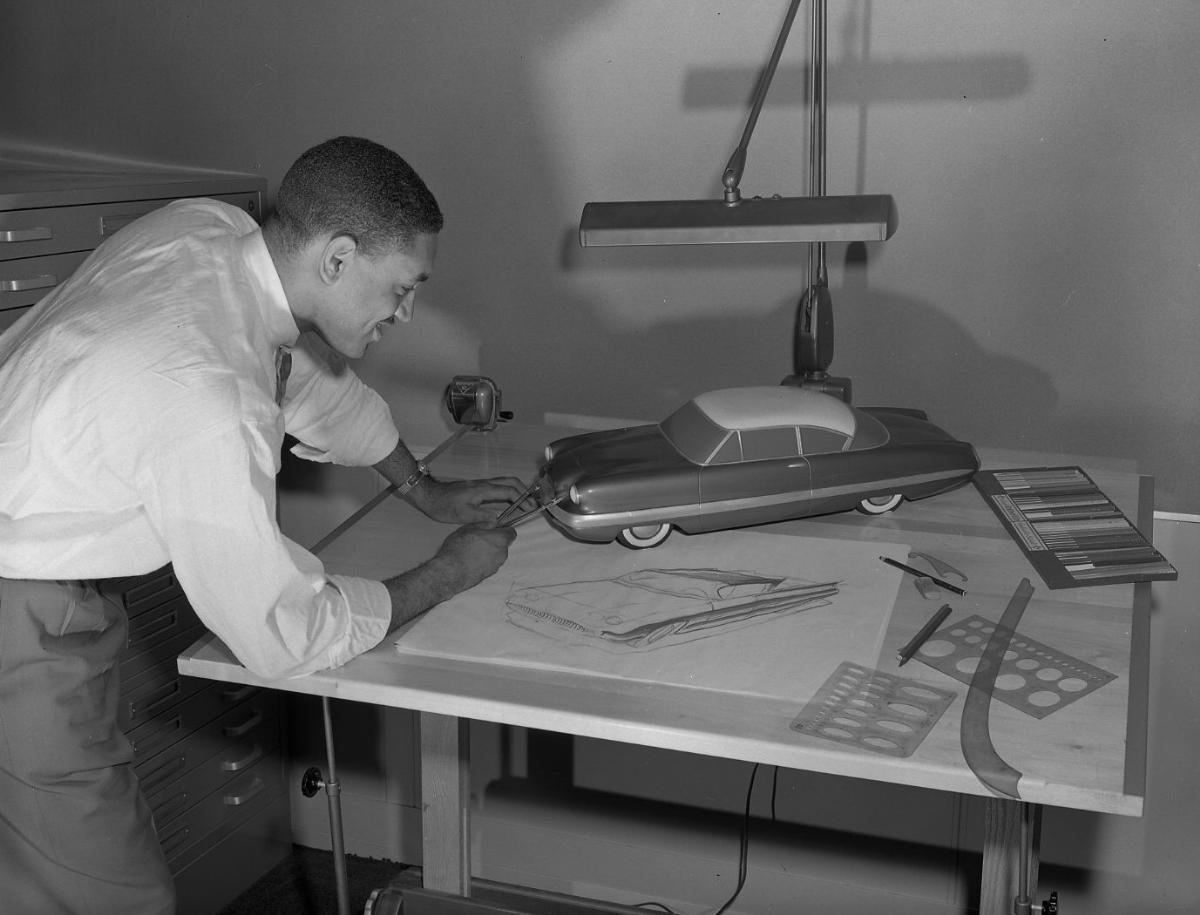
Thompson came up with the open-air, 4 x 4 turbine boxy car that changed the automotive industry. It was a sports utility vehicle known as the Ford Bronco. Look at Thompson’s life and the places he lived, worked, was educated and served. You may find your ancestors in his art classes, in the military unit he served in, other jobs that he held or even in his retirement community.

It is well-known in ancestry and genealogy research African American slavery matter prohibits current-day research efforts about family histories. The blockages that create the brick walls often referred to in African American ancestry research is due largely to enslavers not listing the full names, ages and other identifies for African Americans on the official documents, and the U.S. Census Bureau not including the names, addresses and full demographic information about African Americans until the 1870 records. There were sporadic accounts of slaves’ names and other information by the owners, and the government documents published some information that was linked to African Americans in bondage.
Occasionally, there are uncovered lives of African Americans such as James Forten, considered one of the Founding Fathers of the United States. He was born a free American in Philadelphia, PA in 1766. At age 14, he joined the Continental Army and was a “power boy.” A powder boy carried gun powder from the ship’s magazine to the ship’s cannon. Following in the footsteps of his father, he became a sailmaker. He became his family chief sailmaker in 1798 after the death of his father.

To return to the original concept of this blog, look for any opportunities of your ancestors to be located in the areas that Forten lived and visited. It is likely that your ancestors may have been in the similar line of work or even worked with Forten, or volunteered with his wife and daughters in their abolitionist activism.
As an abolitionist who walked his talk, Forten chose to not work with any slave trade-connected companies and individuals. Forten was brave to adopt this business practice. However, as a man who was aboard a ship that was once captured by the British and he risked being sold into slavery, Forten withstood adversities and became a wealthy man who was also an active abolitionist. He designed and sold innovative sails that allowed ships to gain higher speeds, among other attributes. He was considered the prime sailmaker in Philadelphia and he employed African Americans and whites. He funded popular abolitionist publications and also endorsed his daughters developing the first interracial women’s abolitionist organization, Philadelphia Female Anti-Slavery Society.
So popular was Forten in the abolition movement and as a top employer that upon his death at age 75, his funeral was attended by thousands. Were your ancestors among the mourners?


The last place many African Diaspora ancestors want to research is through the study of slave sales. The writing and imagery are sadly powerful in the historical accounts of financial transactions and public spectacles involving slaves.
Yet, the mostly oddly written newspaper advertisements and posters, often offer great clues to African American, Caribbean American, Native American and European Blacks’ genealogy and ancestry links.
The best clues to tear down the “brick wall” research are found in the names on the ads by the slave owners. Their imprints are often with first and surnames and identities of their family members who would benefit from the sale. The ad below that was posted in the Savannah, Georgia newspaper in 1859, brought more than $300,000 in revenue for Joseph Bryan, whose name appears in the ad. That’s equal to more than $9 million in today’s dollars.
Also, the location of the sale helps to confirm the researchers are on the right track in identifying African Diaspora family members.

The advertisements also include information that is helpful when comparing tax and estate records of enslavers and their sales agents. The ad below also includes a signature that is also important when ensuring the slave owners’ records including African Americans in bondage are accurately connected to genealogy documents.
The ad was published in 1851. In today’s economic terms, the $1,200 to $1,250 is equivalent to approximately $50,000 in today’s monetary terms.
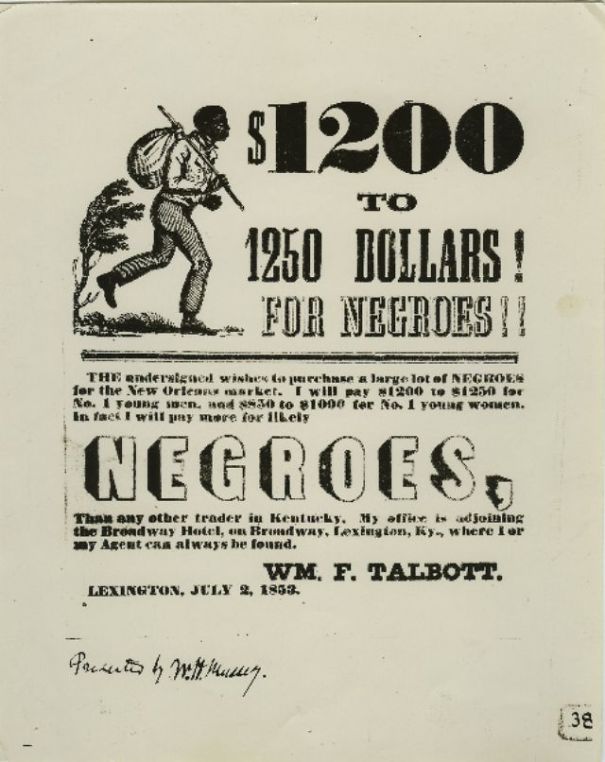
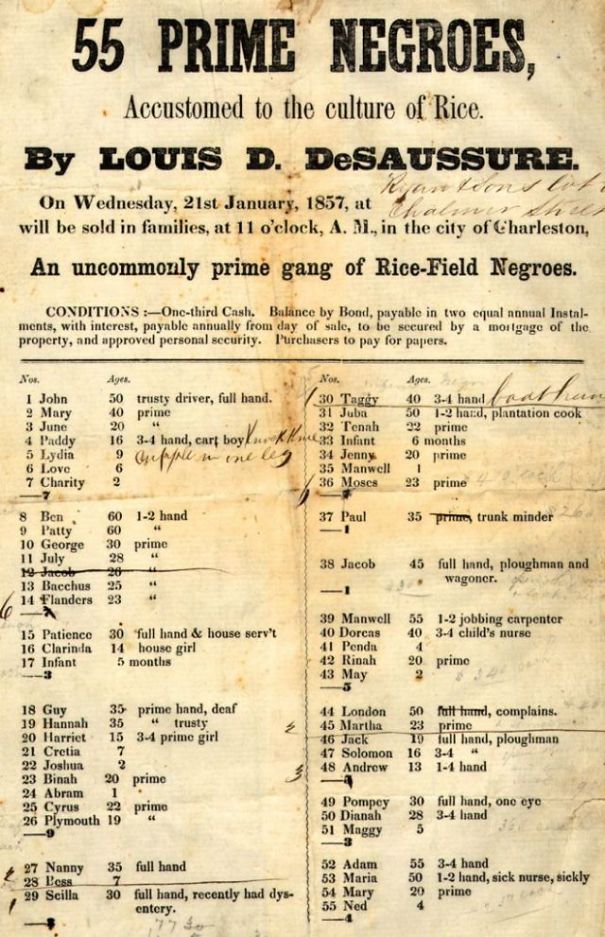
In some instances — albeit rare — slave owners listed the first names and primary trade or unpaid work purposes of the African Americans they owned. This helps African American genealogy, history and ancestral researchers identify legacy relatives. In our genealogy research, typically the slaves’ surnames were those of their owners.
This sale also indicates that the slaves would be sold in families. Sadly and happily, this was considered a huge benefit to the African American enslaved population.

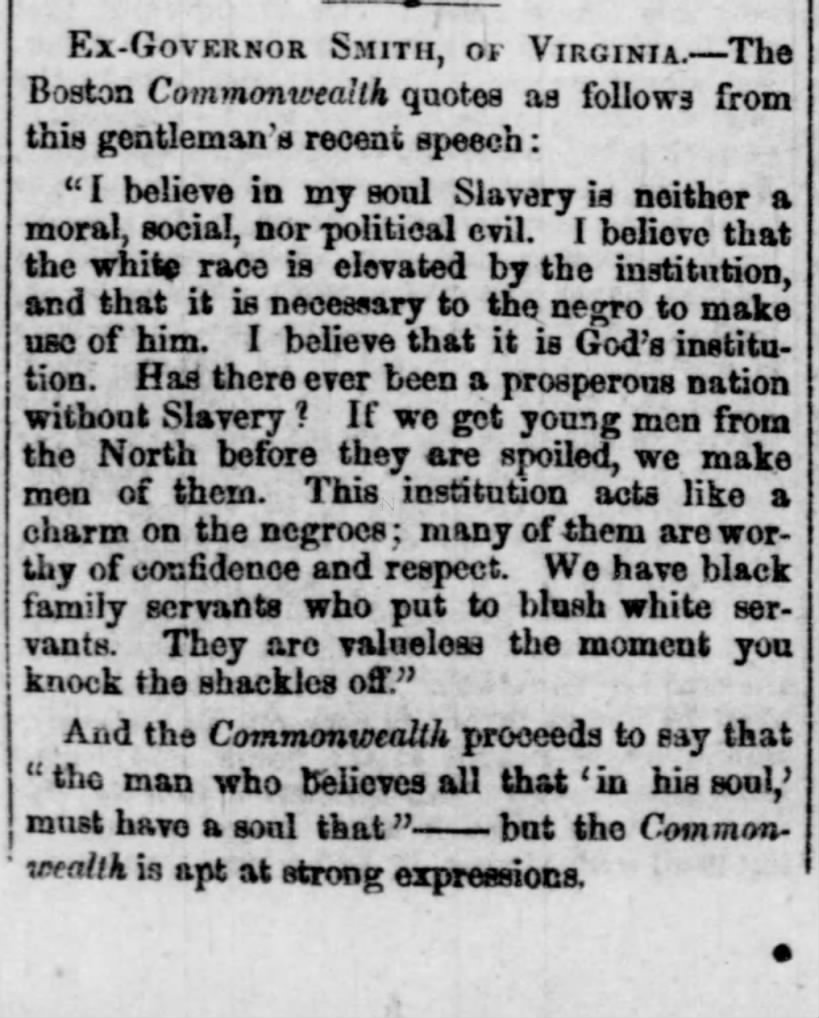
There is an active U.S. discussion about whether African Americans benefited from the horrific ills of bondage and slavery. A Florida governor who is a candidate for the Republican Party’s 2024 nomination for U.S. president is proudly touting such in his state education’s rewriting of history. His appointees are doubling down on the claim that there were productive, career benefits from the skills utilized by African Americans who were enslaved.
This newspaper clipping from a century+ ago is among the documents that mirror today’s comments from proponents of the rewritten history that slavery benefited African Americans.
To all ancestry researchers, search the newspapers for articles in the states where your ancestors resided. It is great insight in what policies and practices they endured while being subjected to the cruelties of forced, unpaid servitude.


The tall dude to the right of the protest sign is Sampson Luster Wead, the paternal grandfather of Ann Lineve Wead Kimbrough of Good Genes Genealogy Service. It is from Ann Lineve’s perspective that this blog is written about a man born on July 2, 1904 in Helena, Arkansas.
This picture appeared in the Omaha World-Herald newspaper on July 31, 1953. It included other photos including the one below that accompanied an article about the successful boycotting of a popular ice cream shop due to its blatant discriminatory hiring practices. I found the picture (above) of my grandfather a few years ago. What I learned today is that there were several articles and likely broadcast reports about this important protest and boycott.

In researching African Diaspora ancestry and genealogy, it is widely known that there are likely several brick walls that will be encountered. It is notable that in researching the facts around the Reed’s Ice Cream Shop protest, I learned three new and compelling things about my grandfather’s character and beliefs:
I learned about the DePorres Club’s purpose from the article found below from the Omaha Star newspaper. Just below the “congratulations grads” ad, is the article about the civil rights organization of the 1940s – today.

Encouragement for the ancestry and genealogy researchers


He was photographed more than Mark Twain and President Abraham Lincoln. He was born a slave and gained freedom, the skills of reading and writing, became a journalist, photographer, orator, author, abolitionist, father, husband and so much more.
With his earned standing in the United States and worldwide abolitionist movement, Frederick Douglass’s words are heeded then and today.
Happy Fourth of July to all. Celebrate it by hearing the sobering and engaging words of Frederick Douglass through the voice of famed, award-winning Actor James Earl Jones. You can download the video or audio versions. Here’s the transcript of this broadcast:
This is a rush transcript. Copy may not be in its final form.
AMY GOODMAN: Today, in this special broadcast, we begin with the words of Frederick Douglass. Born into slavery around 1818, Douglass became a key leader of the abolitionist movement. On July 5th, 1852, in Rochester, New York, Frederick Douglass gave one of his most famous speeches, “What to the Slave Is Your Fourth of July?” He was addressing the Rochester Ladies’ Anti-Slavery Society.
This is James Earl Jones reading the historic address during a performance of Voices of a People’s History of the United States. It was co-edited by Howard Zinn. The late great historian introduced the address.
HOWARD ZINN: Frederick Douglass, once a slave, became a brilliant and powerful leader of the anti-slavery movement. In 1852, he was asked to speak in celebration of the Fourth of July.
FREDERICK DOUGLASS: [read by James Earl Jones] Fellow-citizens, pardon me, allow me to ask, why am I called upon to speak here to-day? What have I, or those I represent, to do with your national independence? Are the great principles of political freedom and of natural justice, embodied in that Declaration of Independence, extended to us? And am I, therefore, called upon to bring our humble offering to the national altar, and to confess the benefits and express devout gratitude for the blessings resulting from your independence to us?
I am not included within the pale of this glorious anniversary! Your high independence only reveals the immeasurable distance between us. The blessings in which you this day rejoice are not enjoyed in common. The rich inheritance of justice, liberty, prosperity, and independence bequeathed by your fathers is shared by you, not by me. The sunlight that brought life and healing to you has brought stripes and death to me. This Fourth of July is yours, not mine. You may rejoice, I must mourn. To drag a man in fetters into the grand illuminated temple of liberty, and call upon him to join you in joyous anthems, were inhuman mockery and sacrilegious irony. Do you mean, citizens, to mock me, by asking me to speak today?
What, to the American slave, is your Fourth of July? I answer: a day that reveals to him, more than all other days of the year, the gross injustice and cruelty to which he is a constant victim. To him, your celebration is a sham; your boasted liberty, an unholy license; your national greatness, swelling vanity; your sounds of rejoicing are empty and heartless; your denunciation of tyrants, brass fronted impudence; your shouts of liberty and equality, hollow mockery; your prayers and hymns, your sermons and thanksgivings, with all your religious parade and solemnity, are, to Him, mere bombast, fraud, deception, impiety, and hypocrisy — a thin veil to cover up crimes that would disgrace a nation of savages. There is not a nation of the earth guilty of practices more shocking and bloody than are the people of these United States at this very hour.
At a time like this, scorching irony, not convincing argument, is needed. O! had I the ability, and could reach the nation’s ear, I would, to-day, pour forth a stream, a fiery stream of biting ridicule, blasting reproach, withering sarcasm, and stern rebuke. For it is not light that is needed, but fire; it is not the gentle shower, but thunder. We need the storm, the whirlwind, the earthquake. The feeling of the nation must be quickened; the conscience of the nation must be roused; the propriety of the nation must be startled; the hypocrisy of the nation must be exposed; and the crimes against God and man must be proclaimed and denounced.
AMY GOODMAN: James Earl Jones, reading the words of Frederick Douglass.

It’s hot outside. It makes one wonder just how they kept cool in those summers. Here’s a post to help you remember and research.


Twenty-four scholars from across the country will spend three weeks in South Carolina, learning how to teach and tell a more complete picture of American history, thanks to a grant from the National Endowment for the Humanities.
“Reconstructing the Black Archive,” a summer institute run by Furman University and Clemson University, will send the scholars, most of whom teach undergraduate students, into churches, historical associations, museums and other sources to learn to recover missing, often intentionally buried, histories.
“These are vibrant sources that tell a history lost to many earlier generations. It’s exciting and thrilling to behold,” said Gregg Hecimovich, Furman professor English, who directs the institute with Furman’s Kaniqua Robinson, assistant professor of anthropology, and Clemson’s Susanna Ashton and Rhondda Robinson Thomas, both professors in the Department of English.
The scholars’ itinerary takes them to sources at Clemson University and the city itself, Columbia and Charleston where they’ll learn from a cast of expertsincluding archivists, literary critics, prize-winning authors, poets and historians, people who have forged the tools for reassembling the scattered shards of information that give a fuller picture of the past.
You can read more in an article by Tina Underwood published in the Furman web site at: https://tinyurl.com/hbxpt2ey.

We love freebies, especially when it helps our genealogy and ancestry pursuits. Here are a few great free workshops, seminars and other events:
Always consult your government sources for free genealogy and ancestry help. After all, if you pay taxes, you’ve paid for these great services. Here’s one of my favorite, basic sites. The details are great refreshers for many of us. For the newbies to the vast research involved in tracing our ancestors, this U.S. National Archives site is terrific, albeit it appears to be complicated. Happy hunting!

That “old” family Bible with authentic inscriptions about births, deaths and other life events such as weddings and baptisms, will serve you well if you are seeking to get a passport yet do not have a birth certificate.
This Freebie Friday tip and more is available on the Good Genes Genealogy social media and our website by the same name. Go to our “Dig a Little Deeper” broadcast site.
Years before the state of Texas received official notification that its enslaved people were free due to the U.S. Emancipation Proclamation, all other rebellious Confederate states complied with the presidential order.
The in-person announcement from U.S. Brigadier General Gordon Granger in Galveston, Texas, came on June 19, 1865.

A month earlier, Confederate General Edmund Kirby Smith, commander of the Trans-Mississippi division, surrendered on May 26, 1865. Days later, on June 2, 1865, General Smith officially laid down his arms at Galveston. He immediately fled the country for Mexico and Cuba as General Smith was deemed treasonous for not following earlier orders to surrender.
While General Smith was slow to surrender his command in Texas, he was accompanied by his valet, a mixed-race slave who was owned by General Smith’s father and believed to be the military leader’s half-brother. Once free, former slave Alexander Hanson Dames, attended two historically black institutions of higher education and earned a degree as a medical doctor. Dames became a well-respected physician whose accomplishments earned him the first statue in Jacksonville, Florida that honored a black man. The statue is situated next to General Smith.
It was a long time coming for Blacks enslaved in Texas who were forced to endure two-and-a-half years more of plantation rules than their counterparts. The General document was welcomed by slaves, yet its last two sentences is deemed controversial by some historians:
“The freedmen are advised to remain quietly at their present homes and work for wages. They are informed that they will not be allowed to collect at military posts and that they will not be supported in idleness either there or elsewhere.”

General Granger’s troops marched through Galveston while some read the General Order No. 3. Their first stop was at the Union Army Headquarters at the Osterman Building.

Next, they marched to the 1861 Custom House and courthouse. The last reading of General Order No. 3 was at what was referred to as “the Negro Church on Broadway” that is known today as Reedy Chapel-AME Church4.
To learn more about Juneteenth, pick up a copy of the Good Genes Genealogy e-book:


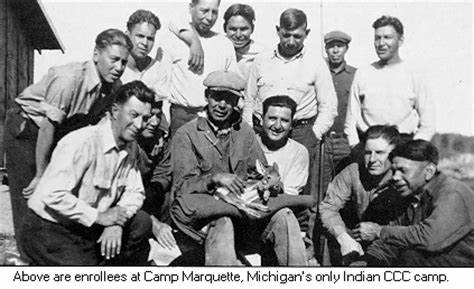
A special, free presentation by the National Archives on May 31, 2023, will highlight a little known program that involved 3 million Native American men who were hired by the United States government to preserve the nation’s natural resources. Known first as the Indian Emergency Conservation Work (IECW) program, and later named the Civilian Conservation Corps Indian Division (CCC-ID), it was part of President Franklin D. Roosevelt’s massive jobs creation initiative.
For genealogists researching their Native American heritage, the records kept by the CCC-ID are tough to assemble because the tribes/nations of Native American were responsible for the record-keeping. The quarterly reports to the federal government were also supplemented by publications such as the one shown above in this post. Those are the most informative pieces of information that will greatly aid in the ancestral searches involving Native Americans.


If there is any doubt that genealogy/ancestry research is capturing the world’s attention, especially, take a look at the latest data collection regarding consumer-requested testing for DNA. The global, direct-to-consumer (DTC) lab testing market is projected to reach $7.92 billion by 2030, growing at an annual rate of 10.9 percent, according to ResearchandMarketing.com.
In 2023, the ancestry/genealogy segment is expected to account for the largest share of the global direct-to-consumer genetic testing market. Factors such as increased consumer interest & curiosity regarding ancestry, technological advancements to make genetic testing accessible, strong advertising & marketing by the companies, high racial diversity and interracial mix in some countries, and the advantages such as convenience & accessibility are driving the growth of this segment.
https://www.globenewswire.com/news-release/2023/05/19/2672626/0/en/7-92-Bn-Direct-to-consumer-DTC-Laboratory-Testing-Markets-Genetic-Testing-Ancestry-Carrier-Status-Disease-Risk-Diabetes-COVID-STD-Routine-CBC-Global-Forecast-to-2030.html
DNA testing is a powerful method for verifying family documents. It can help confirm or refute relationships between family members and verify family documents such as birth certificates, marriage certificates, or adoption papers.
For example, if a birth certificate claims two people are siblings, a DNA test can help confirm this. The DNA test can also show clear relationships between other relatives such as great-aunts, uncles, cousins, and great-great-grandparents.
https://money.com/best-dna-test-kits/

Back by popular requests, we’re offering genealogy and ancestry seekers will find the following freebies to delve into:


In the words of our family’s maternal matriarch, the late Lou Edna Wilks Robinson, “every day is Mother’s Day.”
Born in 1892 as the oldest daughter born in Springfield, Greene County, Missouri, to Melissa Catherine Gray and Robert Wilkes, our “Grandma Robinson” was the glue that kept our family together.

We’ve often wondered how our ancestral mothers were able to accomplish so much in their lives. Except for Grandma Robinson’s birth to two children, including our maternal grandmother, Mary Helen Wilks Owen Douthy, most mothers ‘in her day’ bore several children. Midwives brought babies, especially those of African American heritage, into this world. Indoor plumbing was nonexistent for our ancestral mothers. They grew food, drew well from waters, cooked, cleaned and managed the households. They raised other people’s children, they were our teachers, loyal church members and builders of great legacies admist the harsh societal conditions that often pushed our ancestral mothers to the least known positions.
Yet, our ancestral mothers rarely complained about their fates. Instead, they often rejoiced about the present and future that always included the achievements — known and unknown — of their children and lineage.
We honor you, ancestral mothers.
In 1914, a few years before the birth of our maternal Grandmother Mary Helen, the nation received an official declaration from U.S. President Woodrow Wilson, to honor mothers on the second Sunday in May. The recognition began simple enough: To honor mothers in celebration of peace.
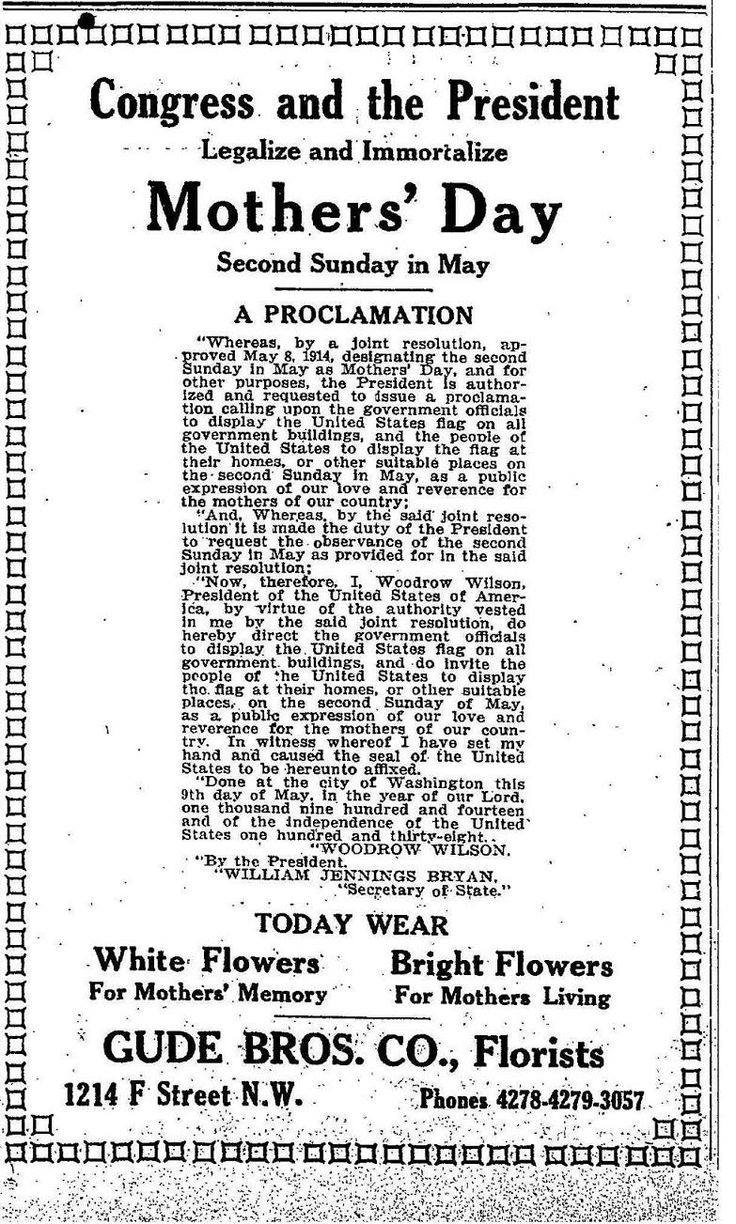
The origins of Mother’s Day as celebrated in the United States date back to the 19th century. In the years before the Civil War, Ann Reeves Jarvis of West Virginia helped start “Mothers’ Day Work Clubs” to teach local women how to properly care for their children.
These clubs later became a unifying force in a region of the country still divided over the Civil War. In 1868 Jarvis organized “Mothers’ Friendship Day,” at which mothers gathered with former Union and Confederate soldiers to promote reconciliation.
Another precursor to Mother’s Day came from the abolitionist and suffragette Julia Ward Howe. In 1870 Howe wrote the “Mother’s Day Proclamation,” a call to action that asked mothers to unite in promoting world peace. In 1873 Howe campaigned for a “Mother’s Peace Day” to be celebrated every June 2.
Other early Mother’s Day pioneers include Juliet Calhoun Blakely, a temperance activist who inspired a local Mother’s Day in Albion, Michigan, in the 1870s. The duo of Mary Towles Sasseen and Frank Hering, meanwhile, both worked to organize a Mothers’ Day in the late 19th and early 20th centuries. Some have even called Hering “the father of Mothers’ Day.”
https://www.history.com/topics/holidays/mothers-day
Happy Mother’s Day.
Free workshops, webinars and other sources of information are offered. We’ve listed several activities.

It’s official name is Deoxyribonucleic acid and that is why it is shortened to DNA to describe “a self-replicating material that is present in nearly all living organisms as the main constituent of chromosomes. It is the carrier of genetic information.”
Genealogists often refer to DNA as putting the “gene” back in genealogy. The Good Genes Genealogy team (Maternal first cousins Mark Owen and Ann Wead Kimbrough) is DNA tested. We are not scientists who can provide you with the details on how the genetic makeup is key to breaking through brick walls and other delays in tracking our family histories. Yet, we’ve utilized DNA in our processes that have helped to build about family members.
Today and this week, we invite you to learn about DNA and its applications to genealogy searches. There are countless free workshops and other sources of information. As you get inside of the virtual and in-person sessions, remember a few key things about the DNA journey:

About 80 miles southeast of Atlanta, Georgia, lies Greene County. In Greene County, Georgia as it was in Greene County, Missouri, and across the nation, Black women midwives were and still are highly regarded.
It was widely proved that midwives saved lives — babies and their mothers. They birthed presidents, preachers, teachers and several family members who will attest to their value in caring for mothers in many communities where healthcare facilities were miles away or nonexistent.
The worth of midwives is especially highlighted in recent data that was shored up with the release of 2021 data by the Centers for Disease Control and Prevention (CDC) that showed a sharp increase in infant mortality, especially among African American women. A century ago, the infant mortality rates were much more severe, yet midwives were credited in successfully bringing babies into the world and saving their mothers. Even slave owners knew this truth.
A study published by the National Library of Medicine found:
We estimated that, relative to current coverage, a substantial increase in coverage of midwife-delivered interventions could avert 41% of maternal deaths, 39% of neonatal deaths, and 26% of stillbirths, equating to 2·2 million deaths averted per year by 2035. Even a modest increase in coverage of midwife-delivered interventions could avert 22% of maternal deaths, 23% of neonatal deaths, and 14% of stillbirths, equating to 1·3 million deaths averted per year by 2035.
Nove A, Friberg IK, de Bernis L, McConville F, Moran AC, Najjemba M, Ten Hoope-Bender P, Tracy S, Homer CSE. Potential impact of midwives in preventing and reducing maternal and neonatal mortality and stillbirths: a Lives Saved Tool modelling study. Lancet Glob Health. 2021 Jan;9(1):e24-e32. doi: 10.1016/S2214-109X(20)30397-1. Epub 2020 Dec 1. PMID: 33275948; PMCID: PMC7758876.
Early African American midwives were important members of their community, even among enslaved individuals. Slave owners used these medical practitioners to ensure the health of their reproducing enslaved women and their newborn infants to expand their labor force. It was also common for midwives to attend to the slave master’s wives during birth as well.
https://nmaahc.si.edu/explore/stories/historical-significance-doulas-and-midwives#:~:text=Early%20African%20American%20midwives%20were,to%20expand%20their%20labor%20force.

This midwife account describes the importance of recognizing Black midwives for their contributions to societal good: “… the story of a poor white boy delivered by a black midwife slave that grew up to be the president that freed 3.5 million black slaves in the United States, and was killed for doing so.” — From The Midwife Slave

There are documentaries, articles, scholarly works and stories within families about the importance and legacy of midwives.
Historically, Black midwives are archived among famous global citizens. Check out this site for more information.
Read more: Changing the world through the unsung missions of Black midwivesCheck out the oriiginal human beat box group. Their vocal moves are amazing.

One of the benefits of researching our ancestors is the “find.” In this case, find is pure gold through the super talented siblings who set the human “beat box” standards. They are the Mills Brothers.
While combing through the online ancestry files of the Good Genes Genealogy Services’ grandfather, Eugene Owen, Jr., this remembrance was round. Our grandfather left Omaha, Nebraska for Los Angeles, Calif. to pursue his dream of becoming a Mills Brother-like entertainer. It was the 1940s and he left a family behind in Omaha, including little girls who would grow up and become our mothers of Good Genes Genealogy Services team members.
Our grandfather’s goal was to form a singing group become as popular as the Mills Brothers, a musical team of siblings whose 40+ years of success began in the 1930s. Our grandfather never achieved the same fame. He likely broke the hearts of our grandmother, “Mama” Helen Wilkes Owen Douthy, and her children and other family members. There are joys and pains in researching our families’ histories and this is an example of wading through all of the materials to get to the truth.
Yet, each time we hear the Mills Brothers’ recordings and watch the more than 20 movies that they appeared in during their stellar career, we think of Grandpa Owen.

Look up the next time you walk up to Southern homes, especially those along the Atlantic Coast in South Carolina and Georgia. On the exterior undersides and interiors, you will likely find the unique color of “Haint Blue” on those structures.

The long-forgotten history of haint — another word for evil spirits — began 300+ years ago. That is when Atlantic coastline Gullah Geechees who represented free or runaway African American slaves, painted their porch ceilings with the faint blue-green dye. It was intended to stave off evil spirits, ghosts and any potential hauntings. It was believed that if the spirits saw the haint blue painting on the underside of porches, they would not dare cross the thresholds that resembled the ocean waters.
According to Gullah folk traditions, blue ceilings and blue doors can keep unwanted specters, phantoms, spooks, and apparitions from strolling in through the front door. It fools them into thinking that the door is part of the sky, that the porch is surrounded by water, that the house is protected by something sublime, more powerful and permanent than a coat of paint. It’s trickery though design, and trickery is something the Gullah people knew well.
https://www.theawl.com/2018/01/haint-blue-the-ghost-tricking-color-of-southern-homes-and-gullah-folktales/
Besides the interior ceilings of porches, the haint blue paint shows up mostly on Southern homes’ front doors, shutters and other key locations.

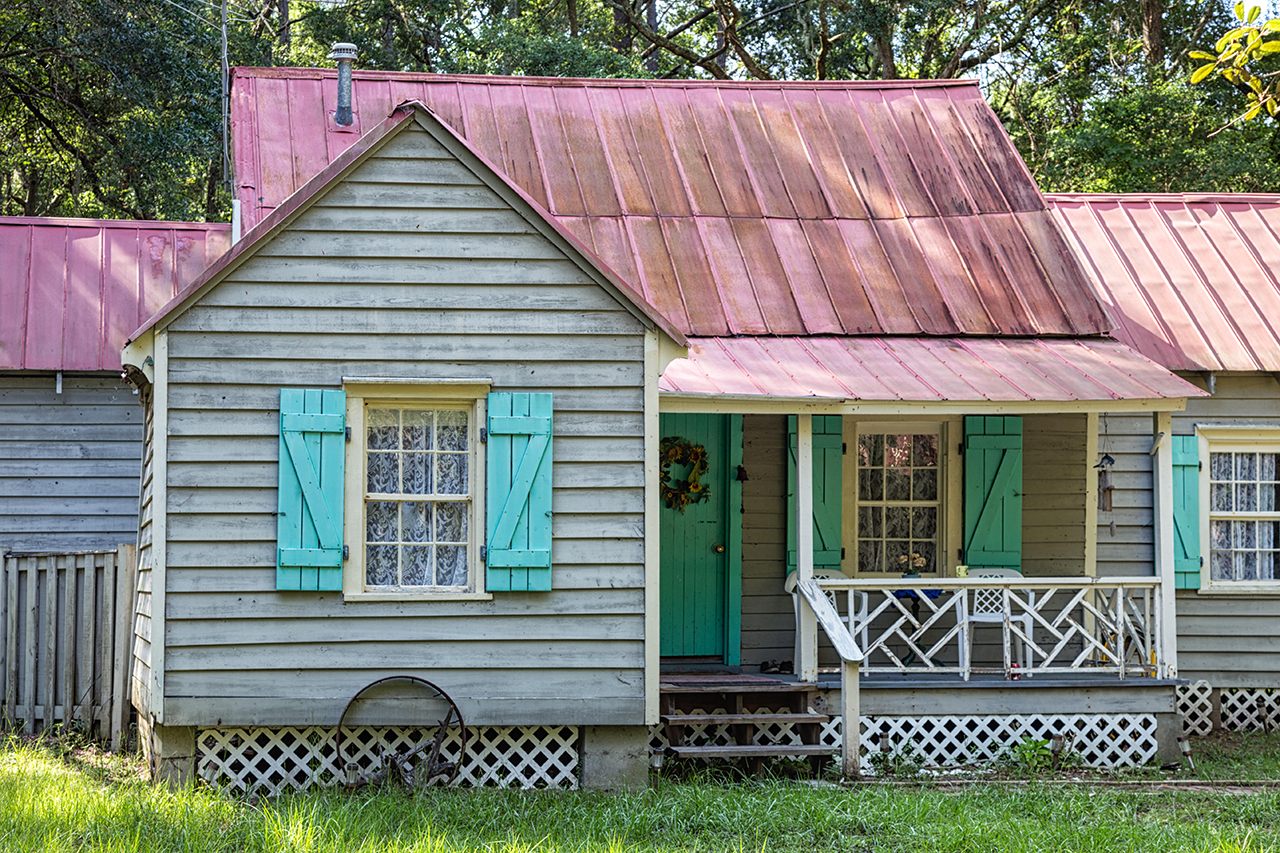 At this Gullah Geechee home on Daufuskie Island, South Carolina, painted doors and shutters keep out evil spirits called “haints.” DAWNA MOORE / ALAMY

Wading through the thousands of files in the Library of Congress, this one stood out because it is the housing projects where my father, Dr. Rodney S. Wead, lived while boy growing up in Omaha, Nebraska.
We don’t know the man and young people in the picture. It was taken three years after Wead was born; his family had not moved into the housing development. In fact, Wead said that they were delighted when they moved into the Logan Fontanelle Housing facility because it was a “big step up” from their impoverished housing a few blocks away in a crowded rooming house.
Keep searching archives. I did. Once my father viewed the photo (see below), he identified the now famous individuals whose families lived in Logal Fontenelle.
Often, we are hit with brick walls in our ancestral searches. There are thousands of photographs that were taken across the country of its citizens — especially Black Americans — as part of President Franklin D. Roosevelt’s New Deal or Works Progress Administration program that included Omaha during the 1930s.

Today, its valued at $604,429.88.

Always keep searching for your ancestors and their stories. Here’s one about someone’s “colored” ancestor, D.H. Johnson, who was farming in February 1897. He hit hard ground while plowing a field near Hogansville, GA. He kept removing the layers of stone until he located what was estimated to be $16,000 in coins, including some from foreign soil.
Today, that would amount to approximately $600,000 according to government calculations. (See above for new estimate). According to this newspaper clipping, Johnson placed the money in the bank. “…the theory is that whoever owned the money hid it out until some secure time, when they would look for it again” the article reported
We are all connected. Ongoing findings among the skilled genealogy and DNA researchers and amateurs, confirm such.
The following two examples offer great hope to those who are steadfast in searching for the accurate stories of our ancestors.
Our favorite PBS show, “Finding Your Roots with Henry Louis Gates, Jr.” regularly features many genealogical surprises among its celebrity guests. A recent episode features well-known human rights activist, professor and author, Angela Davis. Among the startling findings for Davis is that her ancestral roots are traced to the original families who sailed to the early United States on the Mayflower vessel in the 1600s. The Mayflower travelers are attributed to slavery.
Davis’ reaction to Gates’ revelation that was based on sound genealogy and DNA research by his team, went viral with more than four million views in the first 24 hours of the social media posts.

Paul Barber, also a photography hobbyist, from Ontario, Canada, was featured in a local newspaper article to discuss his maternal family, the Hendersons. He traced his family’s travel from Virginia to Canada. He referred to his brick walls as being “stuck in the mud” with his “three times great grandparents. That is, until he dug a little deeper. And deeper.
Barber took the DNA analysis, and it yielded more results. That’s where he learned of his roots in Benin and Togo. It is the time and place where the African Slave Trade was recorded. He said that is how he began to take apart the brick wall, albeit he knew of his Scottish ancestors. It was at that point that Barber said he landed upon a scenario that “he was not fond of.”
What he learned and how he used slower methods of research — regular mail — and current technology to locate his full story, is worth the time one will spend in his recent, hour-long talk. He speaks of the highs and lows of locating ancestors and learning how his family came to include Black people. “I have to know,” he said.
The two examples provided in this blog are examples of the possibilities for amateur-to-professional ancestry researchers. Our pro tips:
In every family, there are countless examples of women who courageously and quietly endured emotional, physical, societal, financial and other pressures. Yet, their lives crafted our family legacies. We are grateful.
To honor them during Women’s History Month, dig a little deeper in your family archives and in the public domain to share their stories of inspiration, even if it seems that they led so-called ordinary lives. To help you get started in honoring our female ancestors, here are a few extraordinary Black women’s stories.
Hanging in Chicago’s DuSable Museum is this quilt handcrafted by a former slave, Melvina Young.
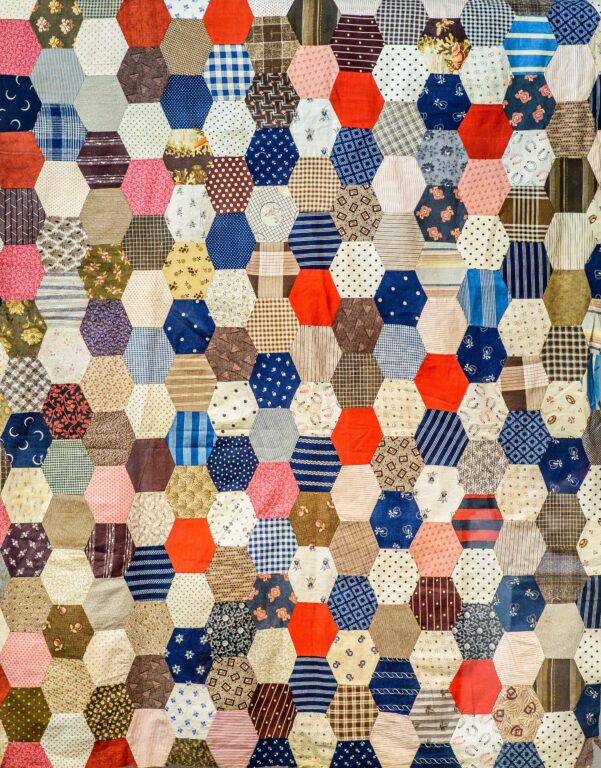
Hand-stitched quilt cover, late 19th century Ms. Young’s “work likely created this quilt cover as free person, having been emancipated after the Civil War ended. Many enslaved people worked in the homes of the plantation owners. A common domestic role was that of seamstress, and Ms. Young probably learned to sew and quilt while working in her owner’s Tennessee home.”
Gift of Daisy Lewis in Memory of Melvina Young
DuSable Black History Museum and Education Center
Black women were vocal about atrocities of the post-Civil War and openly advocated for better health, educational, societal, family and living arrangements. Some of their compelling stories are found here.

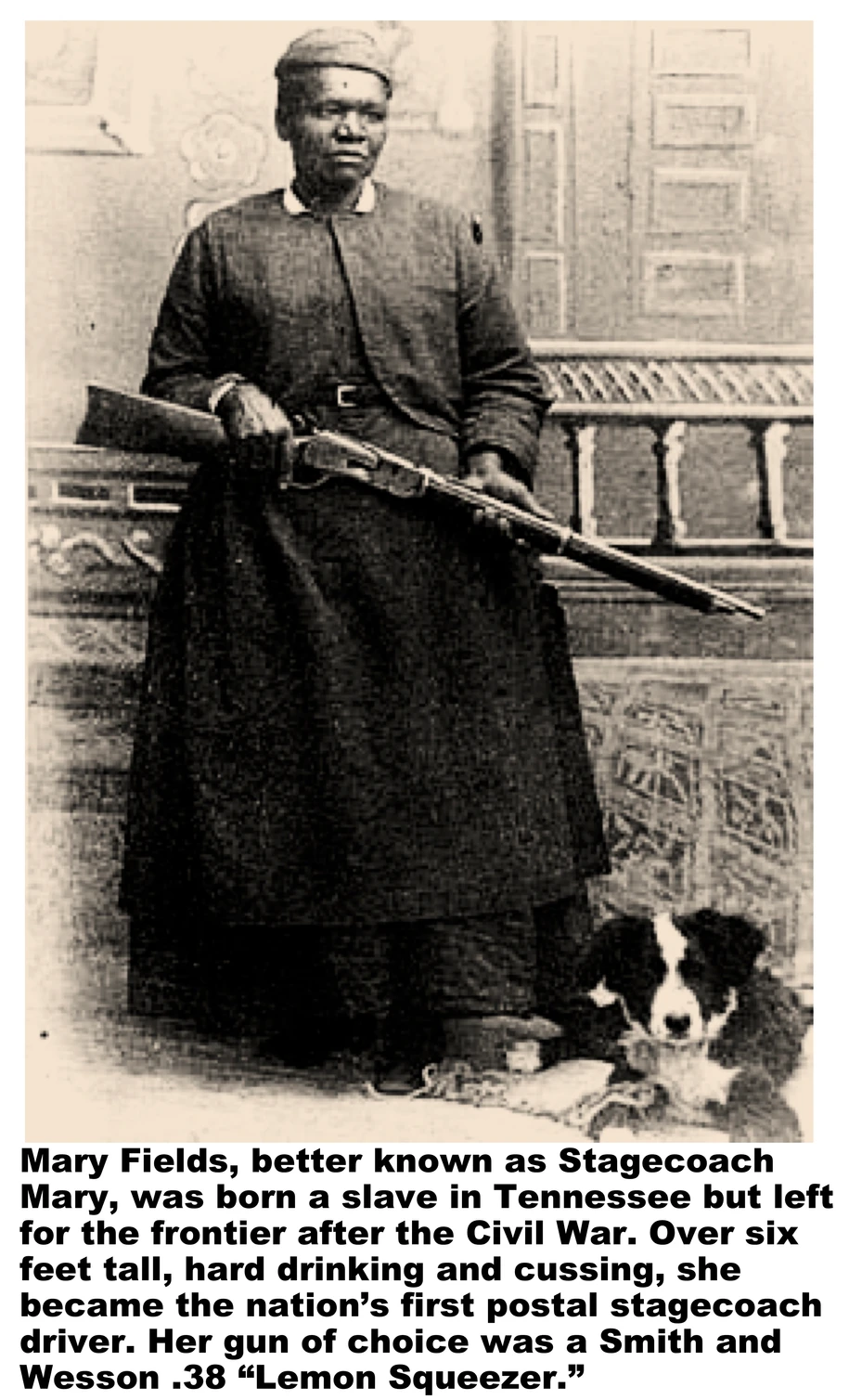
Stagecoach Mary is legendary in many historical circles.
Violette Anderson: In 1926, she became the first Black Women who earned the right to argue before the U.S. Supreme Court
Shown below in The Broad Ax newspaper (July 29, 1922). Courtesy Zeta Phi Beta Sorority, Inc.


Scholarships are regularly awarded to beginning to experienced genealogists. Here are a couple of great opportunities:
Frazine K. Taylor African American Research Scholarship
The Frazine K. Taylor African American Research Scholarship (application due by 1 March each year) is open to anyone committed to expanding their knowledge of African American genealogical research. See attachment for more information.
BCG Paul Edward Sluby Sr. Scholarship for African American Students
application deadline 15 March 2023.
This new scholarship, provided by the Board for Certification of Genealogists (BCG), will be awarded to up to three African Americans “to participate in national genealogical institutes.” The award will “cover up to $1,700 of the tuition, travel, and lodging expenses.” The application requires an essay and a sample of genealogical research. Awards will be made in May 2023 and will be usable for 2024 institutes. To discover more about the scholarship and fill out the application, check out its website.
The scholarship information is courtesy of Afro-American Historical and Genealogical Society, Inc. Metro- Atlanta Chapter www.aahgsatl.org
The Good Genes Genealogy Services duo and Atlanta’s Hillside International Truth Center team up for the last weekend of the free genealogy workshops. The hour-long session is designed to inspire the beginners to seasoned genealogy researchers, and provide everyone with the tools to dig deeper into their families’ colorful histories.
Join us, Saturday, Feb. 18, 2023!


Have you ever wanted to ask questions of your relatives and backed away because it was not “a good time?” We have.
It’s time to get busy. Grab a notepad, make sure your audio and video recorders are sufficiently stocked with new batteries, put on your listening ears and initiate your family research.
It may be uncomfortable for some relatives to open us. That’s natural. Learning what to ask and who to ask questions of, are key to your success. Before you get knee deep in researching family history, make a list of your prospective interview subjects by simply asking, “do you mind if I interview you (or discuss with you) about our family history?”
Once you get to “yes,” you are on your way to discovering the gems and rough spots in your family.

You should seek information from everyone in your family, friends, neighbors, clergy, co-workers of your loved one. Whoever is willing to open up and share, are great informants.


The more your relatives age, the more questions arise about what the loved ones know that can add value to your family’s history.
There are myriad of questions to ask your loved ones in anticipation of great information about your family. One half of the Good Genes Genealogy team — Ann Wead Kimbrough — is a career journalist who’s interviewed perhaps thousands of individuals.
It’s time to edit.
Happy researching!
Ann Wead Kimbrough just received her updated DNA results. She is prone to take daytime naps. Or is she?
Here’s what Ancestry.com found:



If you’re a napper, keep it short—10 to 20 minutes is likely all you need. Longer naps can leave you groggy. To avoid nighttime wakefulness, end your naps before 3:00 in the afternoon.
Missing out on sleep can make you feel hungrier. So taking naps can help you avoid overeating (especially if you nap through dessert).BACK TO SURVEY
Tell us about yourself and your family through some simple survey questions. They’re fun and easy to answer.
Your responses help to improve our products, such as your ethnicity estimate and Traits, and to develop new features, which we hope will bring you a deeper understanding of yourself and your family connections.
We may also share aggregated responses, to give you insights into how your answers compare to others. You can always change or delete the responses on this page. Learn more.
Your answers may also be used for scientific research if you agreed to our Informed consent.OK, got it.
 Morning or night person
 Remembering dreams
 Risk taking
 Omega-3
 Vitamin B12
See which traits are unique to you and which ones you share with your DNA matches.
What affects whether you’re a napper?
Ancestry scientists found a lot of DNA markers (over 46,000) connected to taking naps. Some other markers may play a role too.
People whose schedules require them to rise early tend to take more naps–as do folks whose nighttime sleep is interrupted. And of course, having a daytime schedule that allows for naps makes napping possible in the first place.
Your result is based only on your DNA. We compared your DNA to the DNA of more than 650,000 people who answered the question, “Do you take naps?” The large number of responses makes the data reliable. This test has no medical purpose. Nothing in this report is a diagnosis of a health condition or medical disorder. This report is not a substitute for medical advice. Before making any lifestyle or dietary changes, or if you have any questions about how your genetic profile might relate to your health or wellness, please contact your healthcare provider.
(Thank you, maggie@phillyvoice.com for this great article)

The Patriots of Color archive will be fully digitized and made available online at no cost to the public thanks to a partnership with the genealogy website Ancestry, museum officials said Friday. The Old City museum acquired the documents in 2022 from a private collection, following contributions from several donors.
“At least 5,000 men of color fought in the Continental Army, but their stories aren’t as known as they should be,” said R. Scott Stephenson, president and CEO of the museum. “This archive allows us to explore the extraordinary lives of men who helped to secure independence, yet who have not received the recognition they deserve as American Founders. We are thrilled to have the opportunity to partner with Ancestry to share these rich human stories with the world.”
The documents include Continental Army records related to Jeffrey Brace, who chronicled his life from enslavement to freedom in the 1810 memoir “The Blind African Slave.”
Brace, born in Africa, was not seized by enslavers until he was about 16 years old. He was shipped to Barbados, where he was treated brutally by an English seaman. He fought in the Seven Years War and was purchased by “widow Stiles” in Woodbury, Connecticut in 1768.
The widow taught Brace to read, and he served in the Continental Army. After being discharged in 1783, he was freed by Stiles’ son. His nickname — Pomp London — appears on several documents in the archive. Several years ago, Rhonda Brace, one of Brace’s descendants, visited the home in Woodbury and the descendants of the family that once enslaved her grandfather, six times removed.
“They actually brought us down, my dad and I went — my mother wouldn’t go — we went down to what they believe were the slave quarters in the house,” Brace said. “That was very, yeah … But it was something just to be on the property.”

Go to the Good Genes Genealogy Services website and utilize the forms that we made available especially for participants in our two-part Sankofa Genealogy workshop in partnership with Hillside International Truth Center.
Since the first workshop on Saturday, Feb. 11, 2023, several participants have telephoned, texted, emailed and visited their relatives to gather information needed for their individual family searches. It is healing and helpful for your family and friends to discover their histories.

Way to get the book?
Thank you!
Please join our Hillside family in this month’s Sankofa activities and fellowship.

Join us at 10 a.m., Saturday, Feb. 11, 2023, for a valuable workshop via Zoom designed to prompt participants to find their “lost” loved ones and gain joy, satisfaction, identity and spiritual uplift on the journey. The workshop focuses on Black Genealogy and Ancestry family research and more.

Sankofa Genealogy workshop attendees are asked to purchase the companion workbook. Go to our website and select “Genealogy Store.” You will be able to download your copy after selecting the book cover image (see below) to pay for your book. All proceeds offset our free and low-cost, year-round genealogy consulting services. Kimbrough and Owen are the co-authors and Veverly Byrd-Davis is the book designer and illustrator of the cover.
Part two and final 2023 Sankofa Genealogy workshop will be held at the same time, Saturday, Feb. 18, 2023. Details will be provided next week.


Zoom meeting details
https://us06web.zoom.us/j/86148300328?pwd=R2djSXUrNXI1SFF1TTM1NlJ3S2lZdz09
Meeting ID: 861 4830 0328
Passcode: 02112023
Dial: 929 205 6099 US

‘Back in the day,’ our ancestors’ version of social media was human contact. Stories were shared by village griots about our roots. Physical signs such as smoke were used to communicate. Entries were manually entered into family Bibles. Long visits with food-in-hands were made to families whose loved ones transitioned. Telephone calls were made on rotary dial devices. Telephone company operators connected calls between lines.

Today, there are hundreds, perhaps thousands of daily opportunities for the novice to serious genealogy and ancestry “hunters” to find details about their loved ones. One of the obvious, natural sources of data gathering is apparent in our daily doses of media. Whether current TV newscasts or historical clippings from newspapers, there are photos and stories waiting for us to find and connect them to our ancestors.
Social media is a great source to find relatives. Social media is not limited to Meta, Twitter, Instagram, YouTube, LinkedIn or Pinterest. In 2019, Meriam-Webster Dictionary defined social media as:
“… forms of electronic communication (such as websites for social networking and microblogging) through which users create online communities to share information, ideas, personal messages, and other content (such as videos)…”
Meriam-Webster Dictionary
There are so many sites that apply to this definition and that is where the Good Genes Genealogy Team invites you to begin or resume your ancestry research. According to Datareportal, nearly 5 billion social media users are regular users on thousands of different sites. On average, 7.2 sites are visited each month by users. The top reason why we utilize social media is to remain in contact with living and deceased friends and families. Often, we receive news about the passing of a loved one from social media sources.

To help jog your brain, here are a few of the platforms that are part of our social media community:

Here’s an important tip on locating historical points on the QuizDaily website. It opened clues to one of our client’s family members.
“In 1832, the Georgia Infirmary became the first hospital for African Americans when it opened on Christmas Eve. Established by the Georgia General Assembly and a $10,000 grant from the estate of a merchant and minister named Thomas F. Williams, the Georgia Infirmary was built 10 miles south of Savannah, Georgia. In 1974, the infirmary was renamed the Adult Day Center; it is still an operating facility.”
https://www.quizdaily.com/quiz/61e84610f2c1d0000825d16f?utm_source=intro&utm_medium=email&utm_campaign=63d09d81816737bda7888548


In the worldwide Census data collection and distribution, there are straightforward and confusing results within the same reports. In the U.K. (England and Wales), the percentage of whites, for example, increased in the latest Census due to:
The ethnic groups used in the 2021 Census were slightly different from the 2011 Census ethnic groups.
There were 2 changes in 2021 – the ‘Roma’ group was added under the ‘white’ ethnic group, and people could write their own response under the ‘black African’ ethnic group.
As a result, figures for the white other and black African and black other ethnic groups may not be directly comparable for 2011 and 2021, although the groups concerned account for very low percentages of the overall population.
https://www.ethnicity-facts-figures.service.gov.uk/uk-population-by-ethnicity/national-and-regional-populations/population-of-england-and-wales/latest
The Romani, or Roma as they are known, were once the EU’s largest minority group and now the addition of their population has increased the “white” column in the 2022 U.K. Census data. Romas are counted in the 2022 U.K. Census — actually in two categories. Why? That’s the straight forward-yet confusing data that is found in the U.K. Census.

As a result, the change in how whites and African-connected heritages are reported resulted in the latest data released about the ethnic, Caribbean, African and white populations in England and Wales. The latest results are not comparable to other years.
Over time, here’s what shows up as percentages of the entire population. Note that what I derived from the overall data will not equal 100 percent. See the full table of data:
Population %2021 %2011 %2001
| Black | 4.0 | 3.3 | 2.2 |
| Black African | 2.5 | 1.8 | 0.9 |
| Black other | 0.5 | 0.5 | 0.2 |
| Mixed | 2.9 | 2.2 | 1.3 |
| Mixed White/Black African | 0.4 | 0.3 | 0.2 |
| Mixed White/Black Caribbean | 0.9 | 0.8 | 0.5 |
| Black Caribbean | 1.0 | 1.1 | 1.1 |
| White British | 74.4 | 80.5 | 87.5 |
| White other | 6.2 | 4.4 | 2.6 |
| Roma | 0.2 | N/A | N/A |

The Gov.UK December 2022 report on its ethnic facts and figures are as follows:

The Good Genes Genealogy Services Team is pleased to offer our third annual Black Genealogy workshops, 10 – 11 a.m., Saturdays, Feb. 11 and 18, 2023, in partnership with Hillside International Truth Center, Atlanta, GA. We remain in a virtual setting via Zoom.
https://us06web.zoom.us/j/86148300328?pwd=R2djSXUrNXI1SFF1TTM1NlJ3S2lZdz09
Meeting ID: 861 4830 0328
Passcode: 02112023
Dial: 929 205 6099 US
Hillside’s leadership generously is offering our workshops for free. Cousins Ann Wead Kimbrough and Mark S. Owen, genealogists, are the facilitators for their church’s genealogy workshops. The workshops are open to our worldwide audience.
Kimbrough and Owen specialize in “breaking down brick walls” to find the “hard-to-find” Black ancestors whose histories are usually intertwined with others from contrasting backgounds, such as former slave owners. Kimbrough and Owen have several success stories in helping genealogy workshop participants and other clients to locate their “lost” loved ones. Hillside’s Presiding Bishop Jack L. Bomar, is among those who learned a “great blessing” of family history through the Good Genes Genealogy Services’ research about his family.
Sankofa Genealogy workshop attendees are asked to purchase the companion workbook. Go to our website and select “Genealogy Store.” You will be able to download your copy after selecting the book cover image (see below) to pay for your book. All proceeds offset our free and low-cost, year-round genealogy consulting services. Kimbrough and Owen are the co-authors and Veverly Byrd-Davis is the book designer and illustrator of the cover.
As a preview to the first workshop, we will explore the “natural” and online ways to find your ancestors whose heritage is from the African diaspora. Participants will also learn helpful tips and receive encouragement from the valued benefit of locating and celebrating our individual and collective Black family ancestries.
Don’t you love Black History Month? Although February is the shortest month in days of our calendar year, it is nonetheless a time to pause, respect and relish the fantastic achievements of African American, Black and Caribbean ancestors whose works and lives were largely ignored or never revealed.

That’s where your great genealogy research comes in. This month, hopefully the multitude of U.S. and global Black History Month recognitions, will prompt you to uncover new finds from your family. Tour museums. Visit special sites. Listen to great lectures. Watch broadcasts on public broadcasting and other media channels that provide insight on the lives that were courageously and well lived.
Thanks to the creation of and steadfast lobbying of Dr. Carter G. Woodson, we celebrate Black History Month. Woodson was the second black person to receive a doctorate degree from Harvard University, received two degrees from the University of Chicago, and a bachelor degree in Literature from Berea College. He also studied at the Sorbonne in Paris.

Today, some may shrug our shoulders about Woodson’s academic, literature, social and educational achievements. Yet, pause for a moment and think about when and where and how he accomplished so much after being born to former slaves and in poverty in 1875 to former slaves in Virginia. He worked smart during the era with remnants of the slave codes and other racial threats to his life. Yet, he authored several books, founded major organizations, and although he was never married and had no children, Woodson’s influence is an integral part of Black families around the globe.
Here are a few of the exciting happenings this month to honor Black History, beginning with the Good Genes Genealogy Services workshop:


Please add your Black History Month events and the Good Genes Genealogy Services team will continue to update the great events throughout the month of February 2023.
Thank you for your support. It’s available on our Lulu Publishing site and on Feb. 1, 2023, on all other sites.

Enjoy!

Whenever a prayer is publicly offered in honor of our ancestors, we are honored to publish it:

| MONDAY, JANUARY 30, 2023 I GIVE THANKS FOR MY ANCESTORS |
| Individually and collectively, we are part of a never-ending story. The story has no beginning and no end. Our Ancestors are the keepers of the stories and the secrets. Our Ancestors are reminders of the sacredness of our individual and collective lives. Their truths were passed on to us and continue to live in and through us. We can always tap in and receive the wisdom of their life experience, which is alive and well in our DNA. I listen to the whispers of my Ancestors and the echoes of their souls. I am grateful to know that I am a part of a spiritual lineage that is anchored in divine wisdom. I am guided to do what is right and honorable. I am part of the chain of life. The stories I inherited and tell today liberate those who come tomorrow. Thank you, Faith, in me, through me, as me, around me, through the Christ within. And so it is. |
| With the elders is wisdom; and in length of days, understanding. Job 12:12 |
A founder of the 109-year-old international Black male fraternity, Phi Beta Sigma Fraternity, Inc., was long “missing.” He is now found.
For serious genealogy researchers, it is a joyful and encouraging example of how customized techniques resulted in a fraternity victory and for Black genealogy research.
The absence of Charles I. Brown on earth was recorded beginning in 1924. In 1999, a small group of tenacious Sigmas, led by their “International Historian Mark “Mallet” Pacich, began a search on the whereabouts of their founder.” In 2015, the men of Phi Beta Sigma, found Brown’s body and they commenced with burying him with proper rites. Facts about his whereabouts during the missing years are still trickling into the fraternity.


“He got lost,” said Rev. William Major during a Founders Day program in metro Atlanta. “Through genealogy research … he was found. He died in 1981,” Major said.
Major’s remarks were emotionally delivered in honor of the three founders of Phi Beta Sigma during the 2023 Metro Atlanta Founders Day program that included the fraternity’s sister organization, Zeta Phi Beta Sorority, Inc. The two Black Greek-Letter entities are the only ones constitutionally bound in its founding. Dr. Ann Wead Kimbrough of Good Genes Genealogy Services, Inc. is a member of Zeta Phi Beta Sorority, Inc.

Major and Kimbrough
Rev. William Major, left, and Dr. Ann Wead Kimbrough at their Fraternity’s and Sorority’s Founders Day observance in Decatur, GA. (Photo: Provided by Ann Wead Kimbrough)
On Jan. 9, 1914, on the campus of Howard University in Washington, D.C., Brown, along with A. Langston Taylor and Leonard F. Morse, founded Phi Beta Sigma Fraternity, Inc. Today, the international organization is comprised of more than 150,000 college-educated and professional men, predominantly of African American origin. Since its inception, Phi Beta Sigma has been open to men of all race, religion, class and national origin.
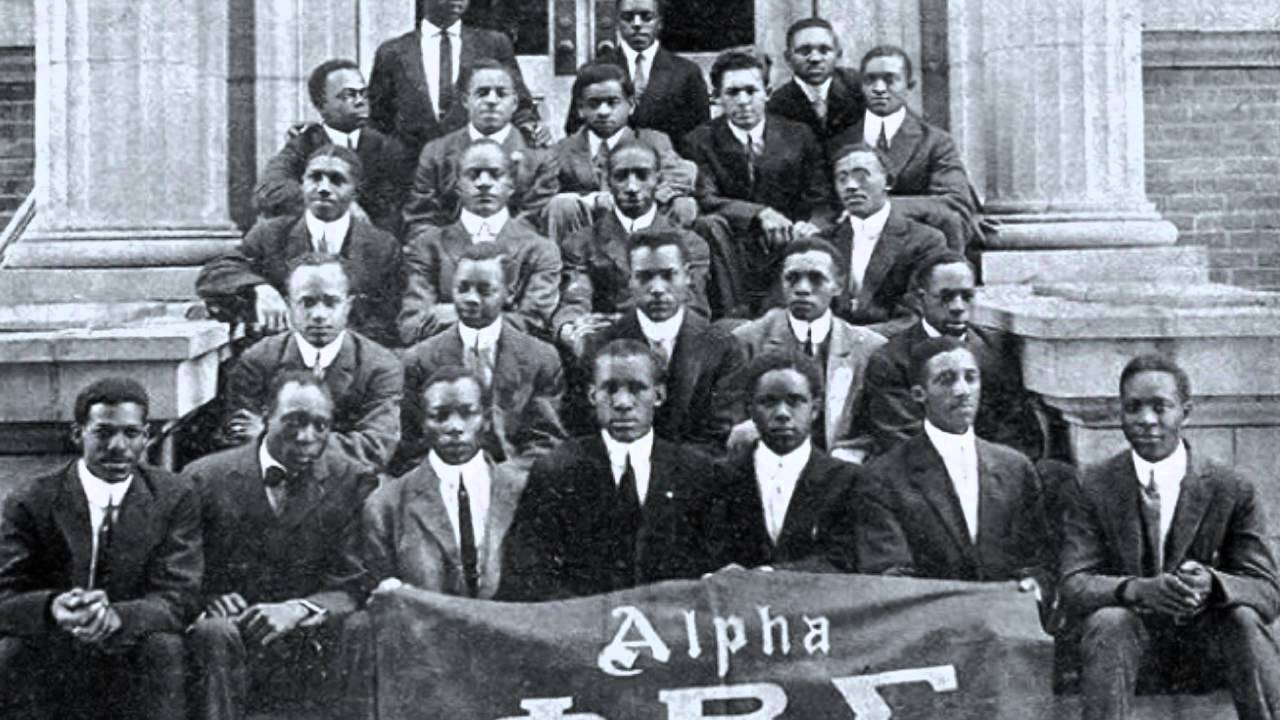
The fantastic search for the Phi Beta Sigma Founder Brown is well documented. What makes the search for Brown remarkable: Full use of available research resources. Flexibility and strategy are the keys to success in genealogy and ancestry research. In one blog, these words are instructive to all researchers:
THE SEARCH FOR CHARLES I. BROWN
The purpose of this blog is to gather information relating to Charles I. Brown. A most honorable founder of Phi Beta Sigma. We by no means claim a patent on the subject, nor are we seeking to upstage those who have done research prior to ours. We are willing to accept any and all help with this project. This is a plea to all brothers if you have any information, be it rumor, gossip or speculation please post it here.
http://charlesibrown.blogspot.com/
That is valuable content within the search-for-Brown blog:
Founder Brown is said to have been born in Topeka, Kansas in 1890. Census records show that his father was Rev. John M. Brown and that his mother was Maggie M. Brown. However, records at Howard University from 1910 have Founder Brown living at 1813 Titan Street in Philadelphia, Pennsylvania. He was very cordial and very popular with the student body and Howard University Administration. He is credited with choosing the 9 charter members of Phi Beta Sigma Fraternity. Founder Brown founded the Delta Chapter of Phi Beta Sigma at Kansas State University in Manhattan, Kansas, on April 9, 1917, and through oral interviews was a teacher at the Kansas Industrial School for Negroes in Topeka, Kansas.
Census records and oral interviews have showed us that Founder Brown was alive in the Topeka, Kansas area until 1931. Some believe that he was a casualty of the First World War; others believe that he moved.
https://charlesibrown.blogspot.com/
While there are several aspects of Brown’s life that has not yet been fully restored, it is heartening to known that his remains were claimed by his beloved fraternity and he was given a proper memorial service. His legacy is worth reading.

Ann of the Good Genes Genealogy Services team began her interest in family genealogy at the age of 10. After asking her mother and paternal grandfather separate questions about their childhoods, siblings, families and more, Ann did not receive the replies she expected. In both cases, I could hear crickets (old schoolers will get the reference).

Yet, as a child, I could have been building the bits and pieces of information that I was able to glean from family gatherings. I was also nosey and wanted to hear the stories from the elders and cousins about what life was like for them in settings different than mine in Omaha, Nebraska. Child-friendly genealogy chart builders like the free ones featured on the National Archives sites are a great start for the young people.

Check out the other freebie from the National Archives. It’s a fresh look in the genealogy tree building exercises.


 As the world becomes increasingly interconnected, the voices and experiences of diverse communities deserve to be heard and amplified.
Among these, the stories of the African Diaspora hold a unique power in shaping our understanding of history, culture, and identity. From the TransAtlantic and Indian Oceans’ slave trades to modern-day immigration, the African Diaspora encompasses the dispersion of African people and their descendants throughout the world.
These journeys have not only carried the physical bodies of African individuals but also their rich heritage, traditions, and stories. Yet, too often, these stories remain untold or distorted within dominant narratives. It is crucial to recognize the importance of unraveling and sharing these stories for a multitude of reasons.
So let’s dive into why the African Diaspora stories must be told and why they hold such significance.
The “Good Genes Minute” will debut August 1, 2026, with short insights on historical stories, and deep connections to African Diaspora descendants. YouTube and Instagram (AnnLineveWeadKimbrough). Join us in this amazing, weekly series.
We will draw from the stories that many have shared with me while I travel throughout the world. I am extending the sharing that so many great storytellers from the Hillside Sankofa Ancestry workshop have provided. Their ancestors are precious and the stories are rich. This is our time. This is the time to honor those who have come before us to teach us lessons that encourage us to lean forward and march ahead.
In a world where diversity and inclusivity are more important than ever, the power of African Diaspora storytelling is much needed. Join us in exploring this rich tradition and discover the strength and inspiration it holds.

As I finished the last sentence of a recent workshop detailing the challenges of locating our African Diaspora ancestors—many of whom survived the horrific voyages across the Atlantic and Indian Oceans—I paused. It occurred to me that while much of my research involves serious and often painful history, there is another side to their lives.
I paused.
Our ancestors experienced hardship, but hardship was not their only experience.
I know from my own character and life that my ancestors had to have a sense of humor. Perhaps that’s why I have always loved laughter myself. Years ago, I even performed in two student productions at Chicago’s renowned Second City Theatre, famous for launching generations of comedians.
Surely my ancestors — and yours — laughed. I’ve heard the stories and as a young child, I experienced the natural humor and fun-loving nature of my paternal aunt, Dr. Beverly Ann Wead Blackburn Jones.
https://www.linkedin.com/company/seventy-five-north-revitalization-corporation/posts/?feedView=all
I didn’t have to imagine what ancestral joy looked like. I saw it in my beloved Aunt Beverly. I recall how my ancestor aunt used her effervescing smile and quick wit to easily lift the mood of any room she entered. This highly regarded educator and community transformer dealt with serious matters and was also a terrific storyteller. As my father, Dr. Rodney S. Wead, described his sister, “she was always the life of the party.”
It was often said that my aunt’s light-hearted attributes were derived from my namesake and great-grandmother, Ann Crum Green. My great-grandmother would keep us laughing by changing her voice to mimic others and blurting funny one-liners that could not be challenged by anyone because she was my paternal family;’s matriarch. Great-grandmother Ann was my Aunt Beverly’s maternal grandmother and likely sparked the humor touch in her. Ann Green was born at the dawn of the 20th century, in the late 1800s, and spent her adult life as a house servant and laundress.
They teased each other. Danced. Dressed up. Fell in love. Gossiped. Told outrageous stories. Sang too loudly. Cooked something everybody wanted. Had nicknames nobody could explain. Took photographs in their best clothes. Went to picnics. Played cards. Courted. Celebrated weddings. Sat on porches. Traveled. Joined clubs. Showed off.
And, undoubtedly, they occasionally got on one another’s last nerve!
African Diaspora genealogy contains difficult truths. Our ancestors experienced hardship, but hardship was not their only experience. They also experienced love, humor, friendship, faith, ambition, creativity, family, food, music, travel, community, accomplishment—and ordinary days that mattered.


That’s what happened to my paternal ancestor, David Lee, in 1820. He could have lost his life. He could have been severely hurt. Instead, he was jailed despite having all of his “papers” in order.
It was published in the Mississippi Free Trader newspaper on September 19, 1820.
David Lee had sufficient documentation to prove he was allowed to walk along the Mississippi pathway. The wording in the newspaper ad gave me the clue that the authorities questioned his paperwork: “…has a recommendation and is called David Lee…” In the early 1800s, the written pass, travel permit, or some type of certificate had to be shown to identify the enslaved.
I discovered this newspaper article while researching my paternal family’s history. Such notices were often placed in Southern newspapers. The hard-to-read print summarizes the plight of my paternal third great-grandfather, David Lee. Here’s the summary of the translation:
It is very challenging to locate and link African Diaspora ancestors to our family trees. For our research, this single advertisement provides confirmation on my ancestor’s connection in our family as I compared his information and timeline to his marriage of another relative.
There were other valuable leads:
- “They say they belong to Villere Allen…” who lived near Baton Rouge.
This last clue is huge because it places my ancestor, David Lee, within the massive forced migration known as the Second Middle Passage. That is when hundreds of enslaved people were sold from the Upper South (especially Maryland and Virginia) to the Deep South after the invention of the cotton gin.

It was pure serendipity. In 1977, while I was a sophomore at Clark College (now Clark Atlanta University) in Atlanta, I obtained a cherished autograph from a U.S. Coast Guard veteran turned legendary journalist and author: Alex Haley, the man who penned Roots: The Saga of an American Family.
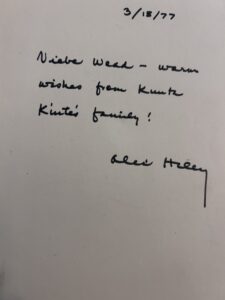
My middle name, Lineve, was shortened into the nickname “Nieve,” which is how Haley addressed me in his note. Just a month after our encounter, he received a Pulitzer Prize, earning a special citation for Roots as “the story of a Black family from its origins in Africa through seven generations to the present day in America.”
The Phenomenon of Roots
Today, there are few people who haven’t heard of, read, or watched Haley’s deeply moving masterpiece. Released in 1976, Roots spent a staggering 46 weeks on the New York Times Bestseller list.
The novel chronicled the life of Kunta Kinte, an 18th-century Mandinka man captured in his West African homeland and trafficked to North America. From there, it took readers through the painful, violent, yet remarkably resilient lives of Kunta Kinte’s descendants in the United States. What made the book so revolutionary at the time was the revelation that these descendants included Haley himself.
Haley was a prolific researcher and writer. His massive literary success didn’t stop with the original book and its groundbreaking initial television adaptation with the Roots Miniseries that aired in January 1977. For eight consecutive nights in my dormitory, Merner Hall, on Clark College’s campus, we were tuned into the impactful video story of our new champion family. I recall how I vowed to follow Alex Haley’s path in locating my long-lost family in Africa and other places around the world. The final chapters of his story were later adapted into the 1979 TV miniseries, Roots: The Next Generations.
Inspiration Amid Controversy
Like thousands of people around the world, I was instantly inspired to research my own African American genealogy. However, the book’s massive success also brought intense scrutiny. A highly regarded historian challenged Haley’s findings, claiming he could not have located the exact village where Kunta Kinte was born. In response to the widespread criticism, Haley gracefully defended his work by reminding the public that he had written a “factional” or “historical novel”—a blend of deep historical research and narrative storytelling.
Looking back, the lessons I learned from that moment as a college student were numerous:
My 30-Year Nudge
Pictured below is my original copy of Roots. As you can see, I simply wore it out from reading and re-reading it so many times.
While Alex Haley gave me the inspiration to vigorously research my family’s roots back in 1976, it ultimately took me 30 years to act on that great nudge. Today, I can proudly boast several hundred newly discovered family members on our family tree. My family tree now stretches back 13 generations across both my maternal and paternal sides, tracing our lines through Switzerland, Africa, Ireland, Germany, Missouri, Mississippi, Georgia, Virginia, North Carolina, and beyond.
The journey takes time—but the reward is looking history right in the face.

One of my favorite places to search for African Diaspora ancestry is the U.S., African American Newspapers, 1829 – 1947 collection. It is one of the few research sources where I willingly become distracted.
I often begin with a specific objective—a person, a family, or another subject that needs solving. Yet often I find myself reading entire newspaper pages. The articles, advertisements, editorials, and community announcements provide a rich understanding of the times in which our ancestors lived.
Sometimes the most valuable discoveries have nothing to do with the individual I originally set out to find.
The African American newspaper collection serves as a critical research center for locating information about African Diaspora relatives who can otherwise be difficult to trace through traditional records. More importantly, these newspapers reveal how Black individuals and communities lived, worked, worshipped, celebrated, and persevered during some of the most challenging periods in American history.
While researching the life of Rev. LeGrand Lee “L.L.” Thomas (born September 1865 in Bishopville, South Carolina, and died April 13, 1917, in Manning, South Carolina), I encountered several fascinating articles in The Gazette on Nov. 21, 1896.
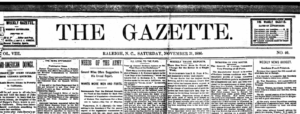
One brief article reported that pioneering physician Dr. Daniel Hale Williams was traveling to Europe with another Black physician to study medical advancements.
In just a few lines, I learned two important facts. First, Dr. Williams was serving as chief of Freedmen’s Hospital (now Howard University Hospital) . Second, he was traveling internationally in pursuit of medical knowledge and professional development. Those details transformed him from a historical name into a living; ambitious professional engaged with the wider world.
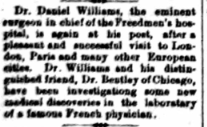
Other articles in the same issue contained a complete listing of Black attendees at a “Colored State Fair” near Raleigh, North Carolina. To a genealogist, such a list can function almost like a community census, documenting individuals who may not appear elsewhere in records of the era.
Then another article captured my attention.
The headline alone was enough to stop me.
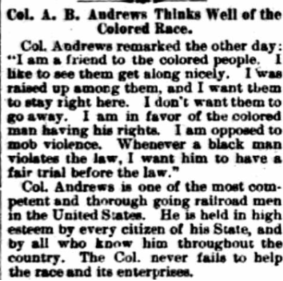
The article was not an advertisement. Instead, it appeared among reports about the Colored State Fair and other community news. Naturally, I wondered why a former Confederate colonel would feel compelled to publicly express such sentiments in a Black newspaper.
Researching Col. A.B. Andrews did not fully answer my question, but I did learn that he:
Although his motivations remain unclear, the article offered a fascinating glimpse into the complex racial and social dynamics of the late nineteenth century.
Beginning with the founding of Freedom’s Journal in 1827, hundreds of Black newspapers chronicled the lives, aspirations, achievements, migrations, and struggles of African Americans.
| Period | Approximate Number |
|---|---|
| Before the Civil War (1827–1861) | About 30 Black newspapers were established. (OUPblog) |
| By 1880 | About 30 Black newspapers were operating nationally. (The New Yorker) |
| By the start of World War I (1914–1917) | Around 300 Black newspapers were being published. (The New Yorker) |
| Entire history of the Black press | More than 3,000 African American newspapers, magazines, and presses have existed since 1827. (Encyclopedia) |
For family historians and professional genealogists, these newspapers preserve stories and personal details that often cannot be found elsewhere. I grew up in Omaha, Nebraska and Chicago, Illinois. I was fortunate that the weekly Omaha Star newspaper was my anchor as a young person who longed to read news about Black people in my community and around the world. The same was true of the Chicago Defender newspaper, an iconic brand in the African American newspaper sector. I am fortunate to brag that I have published articles in both of these historic, dynamic papers that well-serve and served our communities.
By the beginning of World War I, approximately 300 Black newspapers were being published throughout the United States. Over the course of U.S. history, more than 3,000 Black newspapers, magazines, and presses have existed.
These sacred publications documented:
For many African American families, Black newspapers preserve the only surviving evidence that an ancestor lived, worked, worshipped, or contributed to a community.
I eventually located the information I sought regarding Rev. Thomas’s wife. However, the search produced much more than I expected.
Because Rev. Thomas was a well-known minister in the Raleigh community, the newspaper references extended far beyond him. The searches revealed family members, church activities, community events, and social networks connected to his life.
Once again, the lesson was clear. Sometimes we search for one person and discover an entire community.
That is the beauty of African Diaspora genealogy research. The records do not simply tell us where our ancestors lived. They tell us how they lived. Occasionally, we are introduced to people and stories we never expected to find.
zza

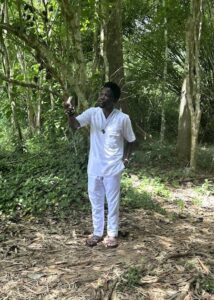
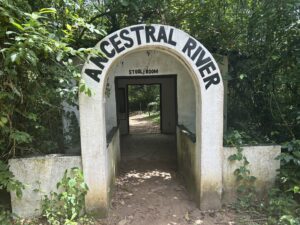
It was an unexpected discovery along the winding, sometimes muddy path leading to what is solemnly known as the Last Bath in Ghana.
Just moments earlier, our guide, Devine, was sharing rhythmic and powerful stories of survival of the men and women whose lives were violently uprooted centuries ago and forced toward an uncertain future across the Atlantic Ocean. His voice carried through the trees as he recounted the journeys of those who passed through this place in chains.
Then, as Devine’s leather sandals were striding down the lightly muddy path, he stopped.
Kneeling beside a place in the path, he pointed to a small patch of greenery and invited several of us to gather around.
“This,” Devine said with a comforting smile, “was the first security system.”
With the gentle touch of his finger, the tiny plant immediately recoiled. Its delicate leaves folded inward as though retreating from the world. Devine explained that the plant, commonly known as the Sensitive Plant (Mimosa pudica), would slowly reopen several minutes later. According to the stories that he shared, the plant’s sudden movements was an alert system for those who may have “disturbed the area.”
“It was a secret system the ancestors used to protect their lands. We still have it here.” He said that if it were not for the grass that has grown up around the special plants, the visitors would be walking on the Sensitive Plant on the way to the actual river of the Last Bath.
“They know that they have seven minutes to catch up with them. After seven minutes it opens back fully and they lose the trail,” explained Devine.
He said the ancestors “were using it as their secret motion sensors. Whenever the ancestors came out to see the plant closed, they knew that something” been there. There is nothing on this earth that is invented by anyone else. Today, you are seeing the proof of our intelligence”.
He referred to the plants as being the equivalent to the modern Ring Door security device: “The most amazing thing is that the security system itself was invented by an African American woman.” He was referring to Marie Van Brittan Brown, an African American nurse, co-invented the first home security system in 1966 with her husband, Albert L. Brown, an electronics technician.
The demonstration lasted only a few seconds, but its symbolism lingered much longer.
Standing at Assin Manso’s Last Bath, a place where countless Africans endured unimaginable loss before beginning the final stage of their forced journey to the coast, I could not ignore the metaphor. Generations of African Diaspora families have carried memories that folded inward for protection. Through genealogy, oral history, and return journeys to places such as Ghana, those memories slowly begin to open again.
More than 100 miles from Accra, Ghana’s capital city, lies the community of Assin Manso, home to one of the most emotionally significant sites in Ghana’s remembrance landscape. Located within the Assin Manso Ancestral Slave River Park, the Last Bath marks one of the final inland transfer points for many enslaved Africans before their forced march to the slave dungeons at Cape Coast and Elmina.
Here, according to historical accounts, captives were brought to the river to bathe before continuing toward the coast. For many, it would be their last physical contact with the interior lands of Africa before boarding ships bound for the Americas and the Caribbean.
We reached the river entry point. We slowly and assuredly walked down the path to the waiting arms of our guide, who had gotten in the waist high water. The water, he observed was higher than in previous years. While the waters were rolling, there was a striking peace. Birds sing from a distance. The trees seemed to welcome its visitors as the branches were swaying gently in the warm breeze. Most of the visitors entered the river, including this writer. It is a cleansing and connecting feeling to African ancestors like no other experience while in this region of Ghana.
Beneath the somberness rests the weight of countless untold stories that would never be known for their lives were lost either through death along the hundreds of miles of marching to an unknown fate, or through the separation and ultimate travel across the Atlantic Ocean to reach lands they never knew.
As the leaves of the Sensitive Plant gradually reopened, our guide reflected on the lessons it offers visitors:
Whether those meanings are found in nature itself or assigned through human reflection hardly matters. At Assin Manso, the symbolism feels undeniable.
For descendants of the African Diaspora, family history often unfolds in much the same way. Names disappear. Stories fade. Connections seem lost. Yet many symbols such as a documents, oral histories, conversations, DNA matches, or a long journey across the ocean, touches the past and awakens memories that may been long folded away.
Interesting finding was right in my backyard. When comparing the look of the Mimosa pudica, I noticed that the leaves of one tree always blooms into a pattern that is identical to Assin Manso’s Secretive Plant. Without any scientific or other professional explanation, it appears the plant was transplanted to my backyard tree.
Like the Sensitive Plant, those stories begin to open again.

Ninety-degree heat. Forty-eight-degree cold.
That was the reality of my journey from Accra, Ghana, to Amsterdam, the Netherlands.
One day, I was standing under the warm West African sun in temperatures reaching 32°C (90°F). Just six hours later, I stepped off a plane into Amsterdam’s chilly spring air of 9°C (48°F), arriving at the start of the country’s largest national celebration—King’s Day.
As I prepared for this international journey from the United States, packing became more than deciding what clothes to wear. I thought of the two continents, multiple climates, different cultural norms, and my optimistic research agenda centered on the African Diaspora and the history of the Trans-Atlantic Slave Trade.
My international travel goals were straightforward:
My so-called challenge was to fit everything needed for ministry, research, tourism, and everyday life into a manageable number of two checked and two carry on bags.
What follows are the lessons I learned—and the items I am glad I packed.
Since 2010 when I first visited Rwanda, Africa as part of my doctoral studies, I learned that research travel requires a different mindset than vacation travel. Whether visiting archives, museums, cemeteries, historical sites, or cultural sites like the botanical gardens in Ghana, researchers need tools that allow us to capture information quickly and accurately.
My two days of research in Ghana at Public Records and Archives Administration Department (PRAAD) generated hundreds of photographs, documents, and observations. I reserved some and had many scanned by the PRAAD team and delivered to me via my Whatsapp because the documents were not deliverable through my email. In Amsterdam, the celebration of King’s Day precluded me from conducting research at its libraries that stored the historical records I was seeking. However, I was able to gather sufficient visual content related to the Trans-Atlantic Slave Trade. A future writing will delve into this with more detail.
In all, being organized matters.
I learned this lesson many years ago while on a mission trip in Costa Rica: Never pack your suitcase completely full. As a research traveler, I inevitably return with books, documents, maps, gifts and souvenirs that help me remember the story. The extra space I left in my luggage proved invaluable. Once I brought a foldable suitcase. Another time, while in Japan, I purchased a suitcase. It was much cheaper to buy it there than in the United States.
I packed far more than clothing, my United States passport, and other travel gear. I packed my high curiosity about the once heavily traveled ship route between the Gold Coast on West Africa and the Netherlands. Those dealings resulted in the most lucrative aspect of the Trans-Atlantic Slave Trade. I packed patience and profound faith to follow history wherever it led. My luggage helped me move between continents. Those internal qualities helped me move between centuries.


In our African Diaspora genealogy and ancestral research, the root of our searches is often right in front of us.
On a recent hot Spring day while visiting Aburi Botanical Gardens — located about an hour up the cool mountain hills from Accra, Ghana — I unknowingly stepped on a leaf connected to history itself. As I walked through the gardens with my tour guide, Maxwell, and my country escort, Prince, Maxwell paused and encouraged me to pick up a dry yellowish leaf from the ground and crush it gently in my hands.
Immediately, a powerful fragrance rose from the leaf.
Mint.
Fresh.
Alive.
The scent startled me.
Maxwell smiled and explained that I had just encountered the African basil known locally as “Scent Leaf,” scientifically called Ocimum gratissimum. It was among the hundreds of plant species found among the 160 acres of exquisitely beautiful lands high above Ghana’s capital city of Accra. The aromatic plant is one of hundreds of species found throughout the gardens’ approximately 160 acres of breathtaking tropical landscape overlooking Ghana’s capital city.
At that moment, what began as tourism quietly transformed into ancestral reflection.
The Gardens were established in 1890 during the British Colonial rule over Ghana. It became a site for agricultural exchange with British rulers and a tropical plant experimentation center. Notable were the plants and trees tied to the former ruling empires and the displacement of people. Some of the plants and trees originated from Brazil, the Caribbean, Sri Lanka, India, and Southeast Asia.
Initially, I believed that visiting the Gardens would be a nice way to end my research, mission travels involving service to young children, and touring, would be a nice way to be a tourist among the African landscapes. Yet, Abrui Gardens demonstrated its ability to allow for remembrances, recovery, and a living memory of what took place on these hallowed ground more than 100 years ago.


At the wise recommendations from my extremely horticulturally knowledgeable guide, Maxwell, I experienced Aburi Gardens with freedom to learn by smelling, tasting, and touching nature’s bounty. It was a form of ancestral reconnection. One of the most powerful realizations from Aburi Gardens is that genealogy does not exist only in documents.
Sometimes genealogy grows from the ground itself.
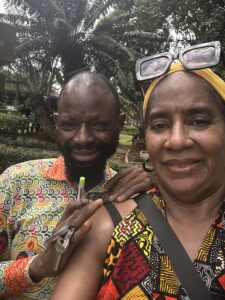
What I did was walk through most of the 160 acres of colonial plant routes and learned about the indigenous knowledge systems that turned plants and trees into medicinal usages. I encountered plants and tree that allowed me to feel and see the shaping of daily African life and diaspora survival. The smelling of the mint, for example, gave me echoes of the trade routes that financially benefited worldwide capitalists who found synthetic solutions from African origins.
It was an experience for the ages.
For researchers exploring African Diaspora ancestry, Aburi Gardens offers important African Diaspora historical clues:
For descendants of the African Diaspora, the gardens offer more than beauty.
My visit to Aburi Botanical Gardens became more than I expected. It was a reminder that Africa still speaks through its landscapes, plants, and people. Sometimes the stories of our ancestors are not hidden in distant archives. Sometimes they are waiting quietly beneath our feet. And sometimes, all it takes is crushing a single leaf in your hand to awaken memory.
In all, there is a lot more to explore involving Aburi Gardens and the African Diaspora connections. I will follow up in future blogs.


While seeking to confirm the identity of a pro bono client’s father, I unexpectedly discovered another way to verify whether a family lineage was accurate. The confirmation came through the grave records of the client’s 15-year-old aunt, who tragically perished in an early morning dormitory fire in south Georgia in 1940.
What followed was another reminder of the twists, turns, and emotional complexity that often accompany African Diaspora genealogy research.
The client and his brother shared the same name as their biological father, who was not married to their mother. The client knew his father’s name, the year of his death, and the alleged location of his burial site. As with most African Diaspora genealogy projects, I began with the traditional route — reviewing the race/ethnic references, names, approximate birth records, death records, and family connections tied to the client’s parents.
Initially, the research moved forward steadily. However, after adding several generations to the family tree, the records suddenly stopped. I had reached a familiar genealogical roadblock.
To work my way out of the blockage, I stepped back and carefully reviewed the foundational details again: The race/ethnic references, names of the client’s parents, their birth dates, death dates, locations, and associated relatives. Yet the challenge remained. The father’s name was common enough that thousands of similarly named men appeared throughout records across the United States. I needed another method to determine whether the individual I was tracing truly belonged to this family line.
I began reviewing every Ancestry.com hint connected to the father’s extended family — parents, siblings, grandparents, collateral relatives, locations, etc. During what I now call a “curiosity detour,” I opened the death certificate of the client’s young aunt.
At first glance, the document confirmed the expected information: Race, parents’ names, approximate ages, and location. But experienced genealogists know that some of the most important clues often hide in the less-obvious details. I mentally noted the funeral home operator and, more importantly, the cemetery listed as her place of burial.
That detail stayed with me.
Next, I searched Newspapers.com for reports of fires involving young women in Georgia during 1940. Initially, I believed she may have been connected to a substantial dormitory fire involving a male residence hall in what is now considered the metro Atlanta area. Yet nothing in those reports clearly linked the young girl to the tragedy described on her death certificate.
So I kept searching.
After hours of research, I paused — one of those quiet moments genealogists understand well — and simply reflected on the question: What really happened here to link this ancestor to my family research?
Then I found it.
An article describing the tragic circumstances surrounding her death confirmed the details listed on the death certificate. My curiosity detour had suddenly become a breakthrough.
But the real discovery came afterward.
Because I remembered the cemetery listed on the death certificate, I began searching for that same burial location among other possible family members. There it was again — the identical cemetery name appearing across generations of relatives. Thankfully, many members of the family had lived and died in a small Georgia town, making the burial connections easier to trace.
The cemetery itself was attached to a small rural church.
That single repeated detail gave me a new level of confidence. The cemetery became the anchor point connecting multiple generations of the family together. Suddenly, the puzzle pieces aligned with greater clarity, allowing me to move more confidently through the family structure and verify that the individuals I was tracing were indeed connected to my client’s lineage.
Only one major question remained: Locating the final burial place of the client’s father in order to construct a fuller timeline of his life. Family accounts suggested he may have been buried nearly a thousand miles away, while other evidence pointed back to the small church cemetery tied to generations of relatives.
But such unresolved questions are familiar territory in African Diaspora genealogy research.
There is almost always another mystery waiting behind the next document, another contradiction buried within oral history, another unexpected clue hiding in plain sight. That is both the challenge and the beauty of this work.
Sometimes the answers we seek are not found in the records we intended to search — but in the records we almost overlooked. Keep searching African Diaspora researchers.